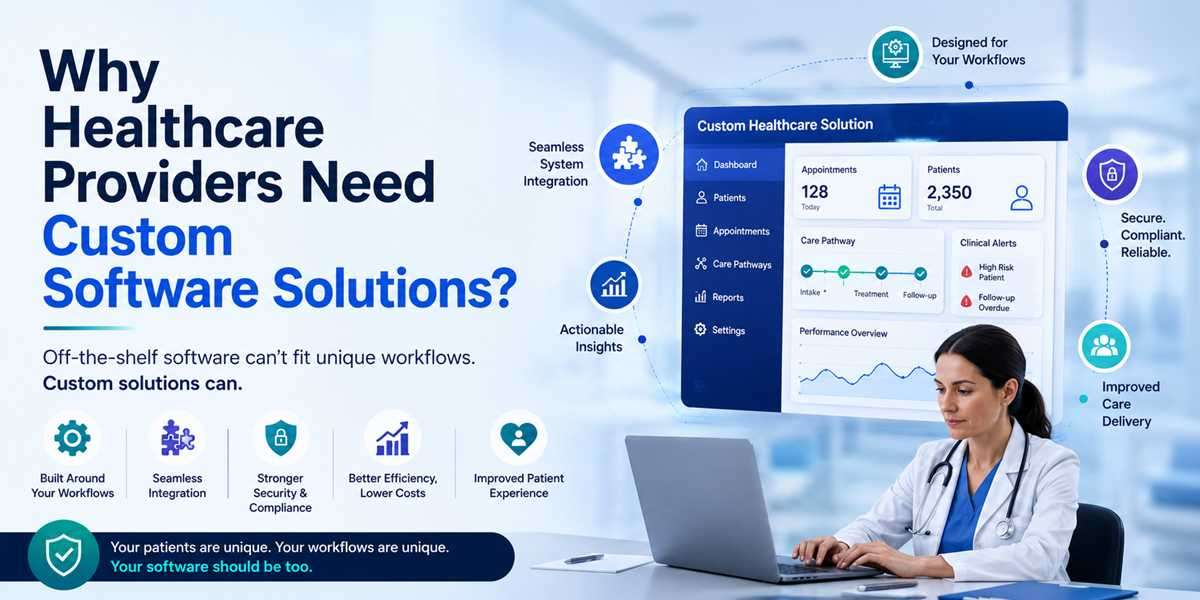

Every packaged software product is an argument about how work should be done. A scheduling module assumes a clinic books appointments a certain way. A billing system assumes a certain claims process. When those assumptions match how a provider actually operates, packaged software is a bargain. When they do not, the provider pays the difference every single day, usually in staff time and workarounds nobody measures. That daily tax is the real case for custom healthcare software development services, and it is more specific than the usual "build versus buy" debate suggests. Many providers also turn to healthcare IT consulting services to identify which workflows should be customized and which are better served by commercial platforms before making major technology investments.
The burden shows up in the people using the software. According to the American Medical Association, 20.9% of physicians spend more than eight hours a week on the electronic health record outside normal working hours, and that figure has barely moved in years. Much of that after-hours "pajama time" is documentation forced by systems built for billing compliance rather than clinical flow. The software works as designed. The design just does not fit the work, and clinicians close the gap with their evenings. Healthcare IT solutions that ignore this mismatch keep the lights on while quietly draining the workforce.
The Hidden Cost of Bending Workflows to a Vendor's Template
Off-the-shelf systems rarely fail outright. They underperform in ways that are easy to rationalize. A nurse clicks through four extra screens because the intake form cannot be reordered. A coder re-keys data because two purchased systems will not share it. A department maintains a spreadsheet on the side because the "system of record" cannot capture something clinically important. None of these is a crisis. Together they become the operating reality, and they compound as an organization grows.
The rationalization is the dangerous part. Teams learn to treat vendor limitations as facts of nature. "The system can't do that" becomes a complete sentence, and workflows calcify around software constraints rather than patient needs. A packaged product optimized for the average hospital is, by definition, optimized for no specific hospital. For the functions that make one provider meaningfully different from another, average is exactly the wrong target.
Consider a cardiology group that built its reputation on a rapid post-procedure follow-up pathway. Patients are contacted on a specific schedule, their readings are reviewed against protocol, and anything abnormal escalates to a clinician within hours. A generic patient-engagement module cannot express that pathway, so the group recreates it with reminders, shared inboxes, and a coordinator who holds the whole process in her head. It works until she takes leave. The advantage that patients actually chose the practice for lives in a spreadsheet and one person's memory, because the software could not hold it. That is precisely the kind of workflow worth owning in code.
Custom Is Not Always the Answer
An honest case for custom software has to admit where custom is the wrong call. Plenty of functions are genuinely commodities. Email, general accounting, standard HR, and much of core electronic health record functionality are solved problems where a mature product will beat anything a provider builds, at a fraction of the cost and with none of the maintenance burden. Building custom software for a commodity function is how organizations end up maintaining expensive, fragile versions of things they could have bought.
Custom development also carries real costs that a subscription hides: engineering effort, ongoing maintenance, security responsibility, and the risk that a project overruns. A healthcare app development company that pretends these costs away is selling, not advising. The right question is never "custom or packaged" in the abstract. It is narrower, and it applies workflow by workflow.
The Deciding Question: Does the Workflow Set You Apart?
Here is the test that cuts through most build-versus-buy arguments. For any given workflow, ask whether it is a source of competitive advantage or simply plumbing. If a process is how the organization differentiates itself, a specialty clinic's unique care pathway, a system's particular approach to patient intake, a model of coordinated care that referring physicians choose it for, then bending that process to fit a generic template surrenders the advantage. If the workflow is undifferentiated back-office plumbing, packaged software is almost always the better choice.
This is the discipline behind the thesis. Custom software earns its cost only where the workflow itself is the competitive advantage. That framing prevents both expensive mistakes: building custom where a product would do, and buying a product that flattens the very thing a provider is known for. Applied consistently, it usually produces a hybrid, with custom software wrapped around a few differentiating workflows and packaged tools handling the rest.
Where Healthcare Software Development Services Earn Their Cost
Three areas repeatedly justify a custom investment, because packaged tools struggle with them by design.
- Differentiated clinical workflows: the specific care pathways, intake models, and coordination processes that define how a provider delivers care and why patients or referrers choose it.
- Integration across a fragmented system landscape: connecting the electronic health record, labs, imaging, billing, and patient-facing apps so data moves without re-keying.
- Patient experience that matches the brand: portals and applications shaped around a provider's actual service model rather than a vendor's generic patient journey.
Integration is where the pain is sharpest. Despite years of standards work, only 43% of U.S. hospitals routinely engage in all four domains of interoperable exchange, meaning they can reliably find, send, receive, and integrate patient data. Most providers run a patchwork of systems that were never designed to cooperate. Custom integration work, and applications built to bridge those systems, is often the only way to make a real workflow function end to end.
Regulation is raising the stakes further: the CMS Interoperability and Prior Authorization Final Rule requires payers to implement standardized data-exchange APIs, with core provisions phasing in through 2027. Providers whose systems cannot speak that language will need development work to comply, regardless of what their vendors ship.
Patient experience deserves the same scrutiny. A portal is often the first and most frequent way a patient interacts with a provider, yet most portals look and behave like the vendor's default rather than the practice behind them. When a health system has invested years in a particular service model, a generic patient journey undercuts it at the exact moment of contact. A healthcare app development company that understands both the clinical side and the interface can shape that experience around the provider's real model of care, so the digital front door matches what patients meet in the clinic. The distinction is not cosmetic. A portal that mirrors the actual workflow reduces confused calls, missed instructions, and the administrative cleanup that follows.
Compliance and Security Are Cheaper Built In Than Bolted On
A frequent objection to custom software is that packaged products come with compliance handled. That is partly true and often overstated. A custom application built by a team fluent in healthcare can embed HIPAA-aligned access controls, audit logging, and encryption from the first design decision, rather than retrofitting them later. The advantage is control: the provider decides how data is segmented, how consent is captured, and how the audit trail is produced, instead of accepting a vendor's fixed answers. Experienced healthcare software development services treat compliance as an architectural input, not a feature added near launch, which is both safer and less expensive than remediation after an audit finding.
Counting the Full Cost, Not Just the License
Build-versus-buy decisions go wrong when they compare a subscription price to a development quote and stop there. The honest comparison runs over years and includes the costs each option hides. A packaged product looks cheaper until the total includes per-seat fees that climb with headcount, paid integrations, customization that still falls short, and the staff hours spent on workarounds the software forced. A custom build looks expensive until the total includes the workflow efficiency it protects and the vendor fees it removes.
Neither answer is universal, which is the point. A provider should price the workaround tax it already pays, then weigh that against the cost of owning the workflow outright. For a differentiating process used thousands of times a day, small per-interaction savings compound into a serious number, and the calculation favors building. For a process run occasionally, the same math favors buying. Running that comparison workflow by workflow, rather than as a single company-wide verdict, is what separates a sound software strategy from a costly reflex in either direction.
Managing the Real Risks of Building
Custom software fails when it is treated as a one-time construction project rather than a product with a lifespan. The organizations that succeed keep the scope disciplined and the delivery incremental. Ship the workflow that hurts most first, prove its value, then extend. Reuse mature components and open standards wherever possible instead of rebuilding solved problems. Plan for maintenance as a permanent line item, because software that touches patient care is never truly finished. A capable healthcare app development company brings a library of healthcare-specific building blocks, so a custom project is rarely built from nothing, and the cost lands closer to assembly than invention. That is where the choice of development partner matters more than the choice to build.
Healthcare providers need custom software solutions in the specific places where their workflows are the advantage, and they are better served buying everywhere else. The discipline is knowing the difference and acting on it workflow by workflow. Custom healthcare software solutions help providers draw that line, build around the processes that differentiate them, and integrate the packaged systems that handle the rest. As interoperability mandates tighten and clinician patience thins, the providers who fit software to their work, rather than the reverse, will spend less time in workarounds and more on care. Start with the workflow that costs the most in daily friction, and decide honestly whether it is worth owning outright. The answer will point to the right custom software investment more reliably than any vendor demo.
Sources
- American Medical Association, Burnout Way Down, Pajama Time Stands Still, 2024. https://www.ama-assn.org/practice-management/physician-health/burnout-way-down-pajama-time-stands-still
- Office of the National Coordinator for Health IT (ASTP), Data Brief No. 71: Interoperable Exchange of Patient Health Information Among U.S. Hospitals, 2024. https://healthit.gov/data/data-briefs/interoperable-exchange-patient-health-information-among-us-hospitals-2023/
- Centers for Medicare Medicaid Services, Interoperability and Prior Authorization Final Rule (CMS-0057-F), 2024. https://www.cms.gov/newsroom/fact-sheets/cms-interoperability-and-prior-authorization-final-rule-cms-0057-f