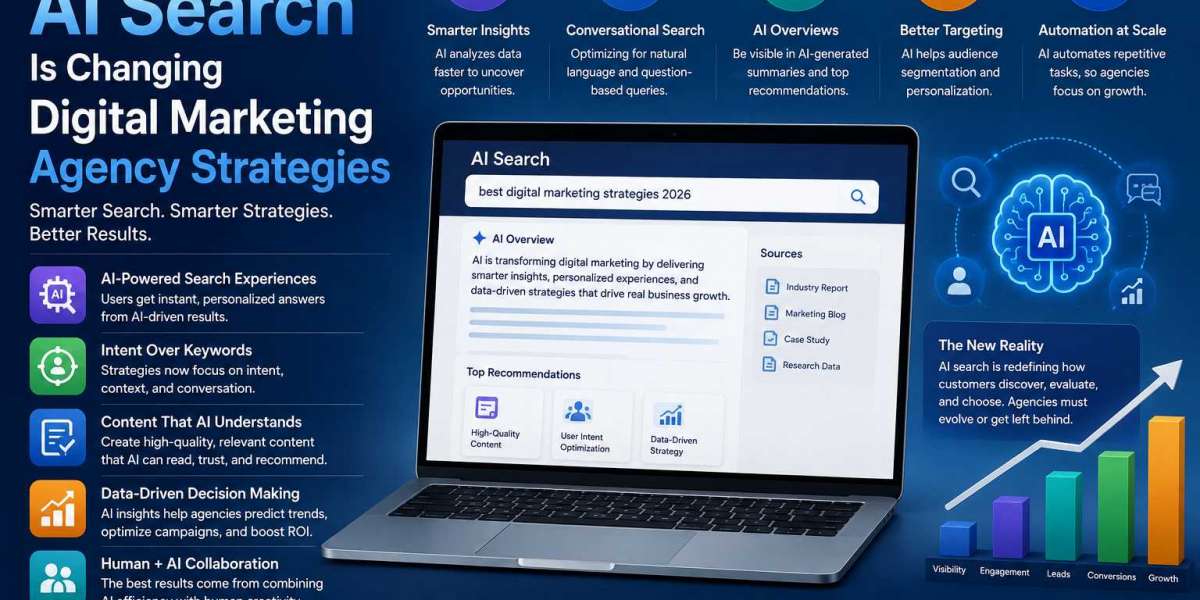

Search behavior has shifted faster in the last two years than in the previous decade combined. Tools like Google's AI Overviews, ChatGPT search, and Perplexity are changing how people find information, and that shift is forcing every digital marketing agency to rethink how it plans, executes, and measures campaigns. What worked for a traditional digital marketing company five years ago no longer guarantees visibility today, and agencies that fail to adapt risk losing both rankings and client trust.
This shift is not a passing trend. It represents a structural change in how search engines interpret queries, generate answers, and reward content. For any digital marketing agency managing client budgets, understanding these changes is now a core part of the job, not an optional specialty. Clients are asking sharper questions about AI visibility, and a digital marketing agency that can't answer them clearly is already falling behind.
From Keyword Matching to Answer Generation
Traditional search worked on a simple premise: match a query to the most relevant page and rank it. AI-powered search works differently. It pulls information from multiple sources, synthesizes an answer, and presents it directly to the user, often without a click. This means a digital marketing agency can no longer rely solely on ranking a page for a keyword. The real goal now is getting cited, quoted, or referenced inside an AI-generated answer.
This has pushed many agencies toward a new discipline often called AI SEO or Generative Engine Optimization. Instead of optimizing purely for ranking position, teams now optimize for clarity, structure, and factual accuracy, since these are the qualities large language models favor when selecting sources to cite. A well-run digital marketing agency treats this as an extension of SEO rather than a replacement for it, since strong technical SEO and clean information architecture remain the foundation AI systems rely on to understand a website in the first place.
Content Strategy Is Becoming More Rigorous
AI search rewards content that demonstrates real expertise and firsthand experience, which aligns closely with Google's long-standing emphasis on trustworthy, people-first content. Thin, templated blog posts that once ranked through volume alone are losing ground. Any digital marketing agency still producing generic content at scale without subject-matter input is going to see diminishing returns.
This has forced agencies to invest more in original research, case studies, and clearly attributed expertise. Content teams are pairing writers with actual practitioners, adding data points that can't be found elsewhere, and structuring articles so key facts are easy for both readers and AI models to extract. A marketing agency in India serving international clients, for example, now needs to prove local market knowledge as clearly as a digital marketing company in USA proves familiarity with domestic regulations and consumer behavior, because AI systems weigh specificity and credibility heavily when choosing what to surface.
Technical Foundations Matter More, Not Less
Some assume that AI search reduces the importance of technical SEO. The opposite is true. Structured data, clean site architecture, fast page speed, and clear internal linking all help AI crawlers and language models understand context accurately. A digital marketing agency that neglects technical hygiene will struggle to get cited even if its content is genuinely strong, because the underlying signals that establish trust and topical authority are still rooted in solid technical execution.
This is exactly the kind of work that separates a serious digital marketing agency from one coasting on outdated tactics. Schema markup has become especially important. Structured data helps AI systems quickly identify what a page is about, who wrote it, and how authoritative the source is. Agencies that were early to adopt structured data at scale are now seeing measurable advantages in AI citation visibility, which is becoming a competitive differentiator that clients specifically ask about.
Local and Regional Strategy Is Being Reshaped
AI search also changes how local visibility works. When someone searches for the best digital marketing agency in India or a marketing agency in India for a specific city, AI-generated answers increasingly draw from a mix of review signals, structured business data, and content that demonstrates genuine regional expertise. This means local SEO and reputation management are converging with content strategy in ways they didn't before.
Agencies operating across multiple regions, serving clients that range from a digital marketing company in India to a digital marketing company in USA, now need consistent, accurate business information across every platform, along with region-specific content that reflects real market conditions rather than templated location pages. AI models are quick to identify shallow, duplicated content, and that hurts visibility across both traditional search and AI-generated results.
Measurement and Reporting Are Evolving Too
Click-through rates are no longer the only metric that matters. As more answers are generated directly on the search results page, agencies are adding new measurement layers, including tracking brand mentions inside AI answers, monitoring share of voice across AI platforms, and analyzing referral patterns from AI-driven traffic. A capable digital marketing agency is now expected to explain these shifts to clients in plain terms and show how visibility is being measured beyond a simple rankings report.
Any digital marketing agency that still relies on a single monthly rankings spreadsheet is giving clients an incomplete picture. This changes client conversations significantly. Instead of presenting only keyword rankings, agencies are building dashboards that combine organic rankings, AI citation tracking, and traditional conversion data. Clients want to know not just where they rank, but whether they are being recommended by the AI tools their own customers increasingly use for research.
PPC and Organic Strategy Are Converging
AI search is also blurring the line between paid and organic strategy. As AI Overviews push organic results further down the page, paid visibility and organic authority increasingly need to work together rather than operate as separate budget lines. A digital marketing agency running integrated campaigns can use paid data to identify which topics and questions are gaining traction, then feed those insights into content and SEO planning, creating a feedback loop that neither channel could achieve alone.
This convergence is pushing agencies to restructure internal teams. SEO specialists, content strategists, and paid media managers are collaborating far earlier in the campaign planning process instead of working in isolated silos, because AI search rewards a cohesive brand presence across every channel rather than isolated wins in any single one.
Adapting Without Losing the Fundamentals
None of this means the fundamentals of good marketing have disappeared, and it certainly doesn't mean every digital marketing agency needs to reinvent itself overnight. Understanding audience intent, building genuine authority, and creating content that actually helps people are still the foundation of every successful strategy. What has changed is the range of surfaces where that authority needs to show up, from traditional search results to AI-generated summaries to conversational search tools.
Agencies that treat AI search as an extension of sound SEO and content strategy, rather than a completely separate discipline, are adapting the fastest. The core skills of research, structure, and credibility still apply. They just need to be applied across more surfaces, with more precision, and with far less tolerance for shallow or generic execution.
If your team is trying to figure out where to start, working with a partner who already tracks these shifts closely can save months of trial and error. SEO Discovery has been helping clients adapt SEO and content strategy to AI search while keeping the fundamentals of quality and trust intact. Reach out to discuss how your current strategy holds up against these changes and where the gaps might be costing you visibility.
As AI search continues to mature, the agencies that succeed will be the ones that combine technical discipline with genuine expertise, rather than chasing shortcuts that AI systems are increasingly good at filtering out. The shift is significant, but it rewards exactly the kind of rigorous, people-first work that good marketing has always required.