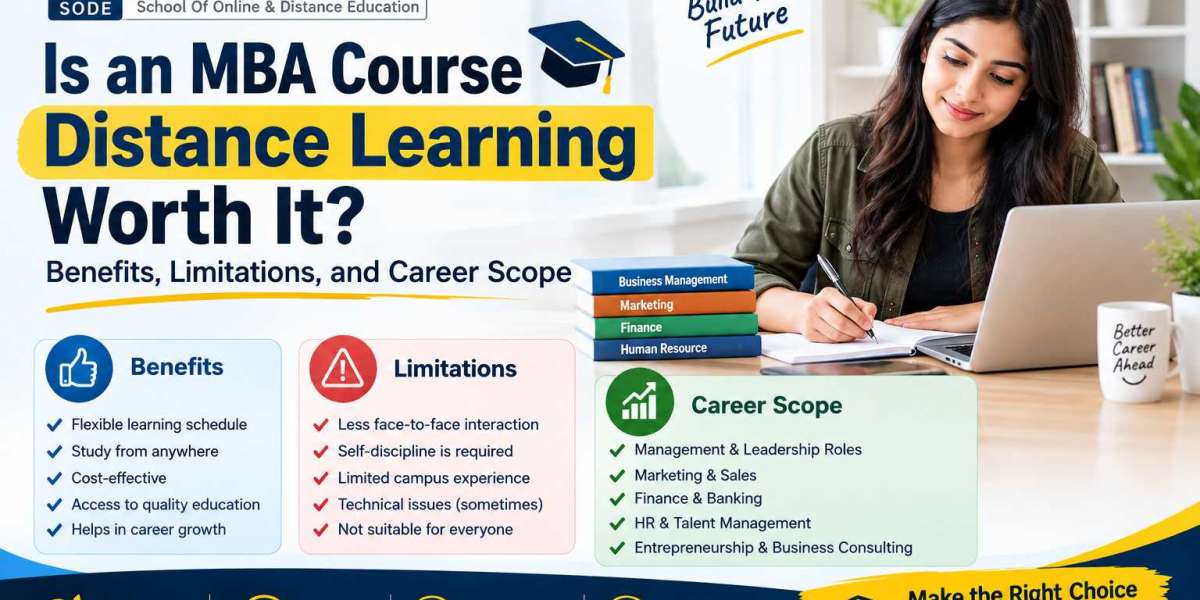

An MBA is a popular postgraduate program for students who want to build knowledge in business and management. However, regular classes aren't convenient for everyone. Working professionals, business owners, and graduates with other responsibilities may prefer a flexible study option.
A distance MBA lets students study management without the same daily classroom routine as a traditional MBA. Depending on the university, students may receive printed study material, online resources, recorded lectures, assignments, academic counselling, or access to a digital learning platform.
The exact course structure and facilities vary from one university to another, so students should check the latest program information before admission.
What Is MBA Distance Learning?
MBA distance learning is a postgraduate management program offered through a distance education system.
Students generally study independently using the learning resources provided by their university. Instead of attending regular physical classes every day, they follow the academic schedule given by the institution and appear for examinations according to its rules.
The course normally introduces students to different areas of business, including marketing, finance, human resources, operations, economics, and strategic management.
Some universities may also offer different specializations as part of their MBA programs.
Who Can Apply for a Distance MBA?
A bachelor's degree is generally the basic qualification required for an MBA.
However, eligibility requirements are not exactly the same at every university. Some institutions may specify:
- A minimum percentage in graduation
- A particular type of bachelor's degree
- An entrance examination
- Work experience for certain programs
- Specific documents
MBA Distance Learning Course Structure
The structure of an MBA generally includes core management subjects in the beginning. Students may later study advanced topics and specialization-related subjects.
Common areas include:
Area | Examples |
Management | Principles of Management |
Marketing | Marketing Management |
Finance | Financial Management |
Human Resources | Human Resource Management |
Operations | Operations Management |
Economics | Managerial Economics |
Strategy | Strategic Management |
Communication | Business Communication |
Research | Research Methodology |
Entrepreneurship | Entrepreneurship Development |
Common MBA Specializations
Students may find several specialization options, depending on the institution.
Marketing
Marketing focuses on customers, branding, advertising, sales, market research, and marketing strategy.
Finance
Finance covers financial management, accounting, budgeting, investment concepts, and financial decision-making.
Human Resources
HR deals with recruitment, employee training, performance management, compensation, and workplace relations.
Operations
Operations management focuses on production, logistics, supply chains, quality, and business processes.
International Business
This area covers international markets, global business operations, and international trade.
Business Analytics
Business analytics focuses on using business data to understand performance and support decisions.
Duration of MBA Distance Learning
Many MBA programs are structured over two years. However, students should not assume that every university follows exactly the same duration.
The minimum and maximum periods allowed to complete the program can vary.
Students should check the current university prospectus for details about:
- Number of semesters
- Minimum duration
- Maximum duration
- Examination schedule
- Assignment requirements
Fees for MBA Distance Learning
There is no single fee applicable to every distance MBA.
The total cost depends on the university, program structure, specialization, and other academic charges.
Students may need to pay:
- Application fee
- Registration fee
- Admission fee
- Tuition fee
- Examination fee
- Study material charges
- Other applicable charges
Benefits of Distance MBA
Flexible Study
Students can organize their study time around their work and personal responsibilities.
Suitable for Working Professionals
Professionals can continue their employment while studying, subject to the program requirements.
No Daily Classroom Routine
Students who cannot attend regular classes may find the learning format more convenient.
Opportunity to Continue Gaining Experience
Working while studying can allow professionals to connect management concepts with practical workplace situations.
Career Opportunities After MBA
An MBA can help graduates explore several business functions.
Possible roles include:
- Marketing Executive
- Business Development Executive
- Sales Executive
- Sales Manager
- HR Executive
- Operations Executive
- Management Trainee
- Project Coordinator
- Customer Relationship Manager
- Financial Analyst
- Business Analyst
Skills to Develop Alongside MBA
Students can improve their career preparation by learning practical skills such as:
- MS Excel
- Data analysis
- Business communication
- Presentation
- Digital marketing
- Financial analysis
- Business analytics
- Project management
- Leadership
- Negotiation
These skills can help students apply management concepts more effectively.
What to Check Before Admission?
Before choosing an MBA program, students should check:
- University
- Eligibility
- Program duration
- Complete fee
- Curriculum
- Specialization
- Learning resources
- Examination system
- Student support
- Current recognition or eligibility applicable to the program and admission session
Final Thoughts
MBA distance learning can be a useful option for graduates and working professionals who need flexibility while pursuing management education.
The program can provide knowledge in areas such as marketing, finance, HR, operations, strategy, and business management.
However, students should choose carefully. Check the current program details, fees, eligibility, curriculum, learning system, and applicable recognition before taking admission.
A clear career goal and regular study can make the learning experience more valuable.