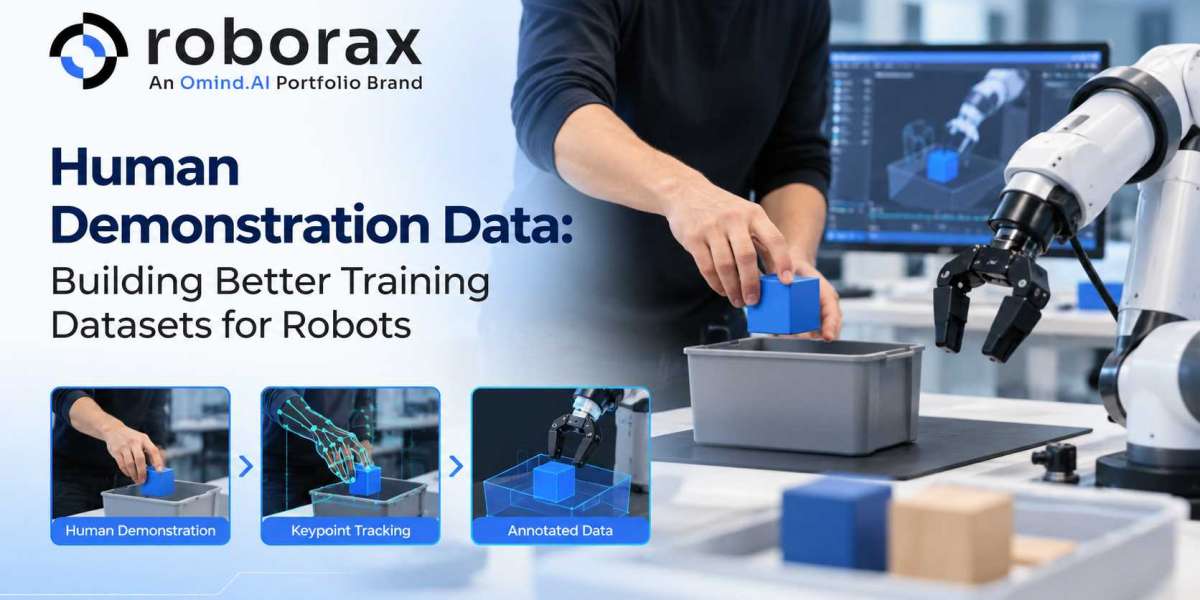

Teaching robots to perform useful tasks requires more than powerful hardware and sophisticated algorithms. Robots need high-quality examples of how tasks should be performed, how objects behave, and how actions change according to different environments. This is where Human Demonstration Data for Robot Learning becomes increasingly valuable.
Human demonstrations provide robots with examples of real-world behavior that can be transformed into robotic training data for imitation learning, behavior cloning, manipulation, and other learning-based approaches. Instead of programming every movement manually, developers can use demonstrations to show robots what successful task execution looks like.
For robotics teams building capable and adaptable systems, the quality, diversity, and structure of these demonstrations can directly influence model performance.
What Is Human Demonstration Data?
Human demonstration data consists of recorded examples of people performing tasks that a robot is expected to learn. Depending on the collection method and learning objective, a dataset may contain video, hand or body movements, object interactions, trajectories, sensor readings, task instructions, and other contextual information.
Demonstrations can be captured through several approaches, including:
First-person or third-person video recording
Motion-capture systems
Teleoperation interfaces
Kinesthetic teaching
Wearable sensors
Hand and object tracking
Augmented or virtual reality interfaces
The resulting data can then be synchronized, processed, annotated, and converted into formats suitable for robot learning.
Research has demonstrated the value of diverse human and robot demonstrations for imitation learning. For example, the MIME dataset contained thousands of demonstrations covering multiple manipulation tasks, illustrating how broader task diversity can support research into trajectory prediction and multi-task robot learning.
Why Human Demonstrations Matter for Robot Training
Traditional robotics often depends on manually engineered rules or carefully designed control policies. These approaches can work well in structured environments but become difficult to scale when robots must operate around changing objects, environments, and human behaviors.
Human demonstrations offer a different approach.
A person naturally adjusts movements based on visual information, object position, friction, obstacles, and task requirements. Capturing these decisions gives learning systems examples of how actions correspond to changing conditions.
For example, consider a robot learning to place products into a storage container. A demonstration can capture not only the final placement but also how the human approaches the object, adjusts the grip, changes the movement when an item shifts, and completes the task.
Such examples can help models learn relationships between observation, action, and outcome rather than simply memorizing a fixed sequence.
Building High-Quality Robotic Training Data
Collecting demonstrations is only the first step. A useful dataset must be designed around the eventual robot-learning objective.
1. Capture Task-Relevant Context
A demonstration should contain enough information for a model to understand what happened and why. Depending on the task, this may include RGB or depth video, robot state, hand position, object location, environmental context, and action sequences.
Synchronizing these modalities is particularly important. A mismatch between visual observations and corresponding actions can introduce noise into the training dataset.
2. Include Multiple Demonstrators
A dataset based on one person's behavior may unintentionally encode individual habits rather than the underlying task.
Using multiple demonstrators introduces variation in movement style, speed, approach, and interaction strategies. This can help models learn more generalizable task representations.
Diverse demonstrations are particularly important when robots are expected to operate in natural environments rather than highly controlled laboratory settings.
3. Capture Successful and Challenging Examples
A dataset should not consist exclusively of perfect demonstrations.
Real-world robotics involves uncertainty. Objects can move unexpectedly, grips can fail, and environmental conditions can change. Capturing variations and recovery behaviors can provide valuable information for developing more robust policies.
Research on offline learning from human demonstrations has found that demonstration quality can significantly affect learning outcomes, reinforcing the importance of carefully curated datasets.
4. Annotate the Demonstrations
Raw recordings rarely provide everything a learning system needs.
Annotation can identify:
Task start and end points
Individual actions
Object interactions
Grasp events
Contact points
Movement phases
Success and failure states
Human intent
Object attributes
Environmental conditions
These labels make large datasets easier to filter, analyze, and use for specific training objectives.
From Human Demonstrations to Robot Policies
One major application of human demonstration data is imitation learning.
In a simplified behavior-cloning setup, a model observes what happened during a demonstration and learns to predict the corresponding action. Over many examples, the model can develop a policy that maps observations to actions.
However, transferring human behavior directly to a robot is not always straightforward.
Humans and robots have different body structures, sensors, degrees of freedom, and control interfaces. A human hand, for example, cannot always be directly translated into the movement of a robotic gripper.
This creates an embodiment gap.
Modern data pipelines address this challenge by representing demonstrations through transferable concepts such as object states, task phases, spatial relationships, trajectories, and action primitives. Some approaches also combine human demonstrations with robot-generated trajectories to bridge the gap between human behavior and robotic execution.
Multimodal Data Makes Demonstrations More Valuable
Robots interact with the physical world through multiple sensory channels. Consequently, relying on a single video stream may limit what a dataset can teach.
A richer robotic training data pipeline can combine:
RGB and depth imagery
3D spatial information
Robot joint states
End-effector trajectories
Force and tactile information
Audio
Human motion
Object states
Task instructions
When these modalities are properly synchronized, models can learn relationships between what a robot sees, how an object responds, and which action follows.
This is especially relevant for complex manipulation, humanoid robotics, warehouse automation, and human-robot collaboration.
Data Diversity Is as Important as Data Volume
More demonstrations do not automatically mean better training.
A dataset containing thousands of nearly identical demonstrations may provide less learning value than a smaller dataset representing meaningful variation.
Effective Human Demonstration Data for Robot Learning should consider diversity across:
People
Objects
Environments
Lighting conditions
Object positions
Task variations
Interaction styles
Success and recovery scenarios
Data diversity helps reduce overfitting and gives learning systems more opportunities to identify the underlying structure of a task.
Simulation and data augmentation can also expand limited demonstration datasets. Research has explored augmenting simulated human demonstrations to improve robustness against variations in object geometry, lighting, and initial conditions before transferring learned policies to physical robots.
Quality Control Should Be Built Into the Dataset Pipeline
Human-generated data can contain inconsistent movements, incomplete demonstrations, incorrect labels, occlusions, and synchronization errors.
A structured quality-control process should therefore include:
Demonstration validation
Sensor synchronization checks
Annotation review
Duplicate and low-quality sample removal
Task-boundary verification
Metadata validation
Dataset versioning
Sampling and distribution analysis
Quality control becomes especially important as datasets scale across multiple contributors and collection environments.
How Roborax Supports Better Robot Learning Data
Building useful robotics datasets requires more than collecting recordings. The data must be designed around the robot's learning objective and transformed into structured, consistent, and usable training resources.
Roborax focuses on data solutions for robotics and Physical AI applications, supporting workflows involving human demonstrations, robot interactions, multimodal data, annotation, and dataset preparation.
By combining careful collection strategies with structured annotation and quality assurance, organizations can build datasets that are better suited for training robots to perceive, reason, and act in complex environments.
Conclusion
Human demonstrations provide an important bridge between human expertise and machine learning. They allow robotics teams to capture practical behaviors that are difficult to express through conventional programming alone.
The real value, however, lies in transforming demonstrations into high-quality, diverse, well-structured robotic training data.
From multimodal capture and annotation to quality control and dataset diversity, every stage influences how effectively robots can learn. As robots move beyond controlled environments and begin handling increasingly complex physical tasks, Human Demonstration Data for Robot Learning can become a critical component of scalable robot training pipelines.
For organizations developing intelligent manipulation systems, humanoids, autonomous machines, and Physical AI applications, investing in high-quality demonstration datasets today can provide the foundation for more capable and adaptable robots tomorrow.