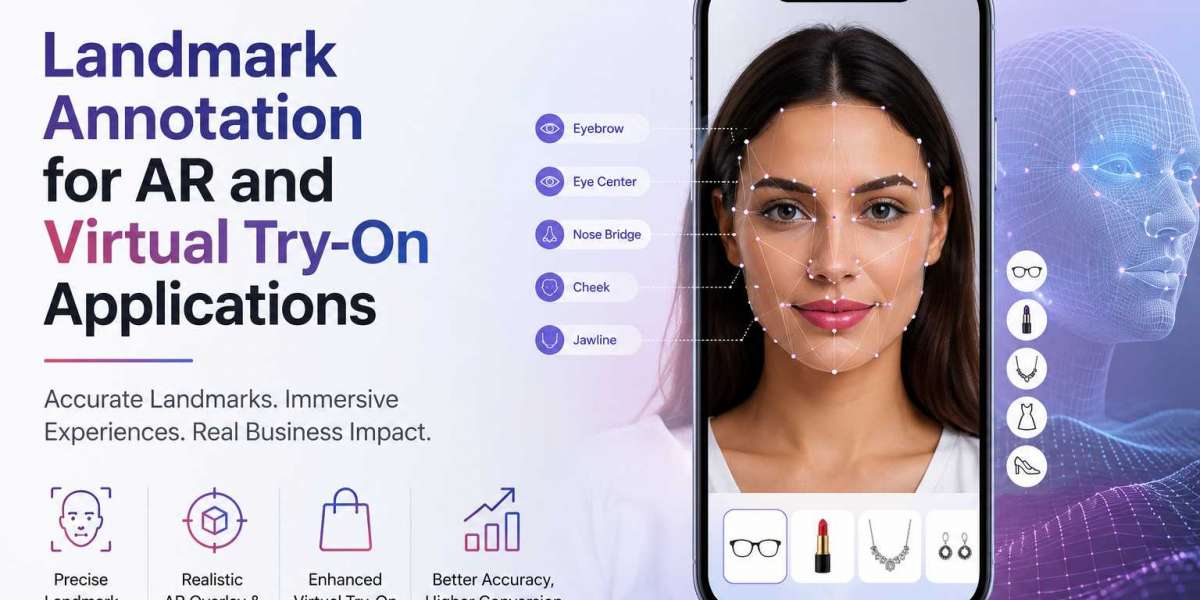

Landmark Annotation for AR and Virtual Try-On Applications
Augmented Reality (AR) and virtual try-on technologies are reshaping how consumers interact with products online. From trying on eyeglasses and makeup to visualizing jewelry, footwear, and apparel, these AI-powered experiences help customers make informed purchasing decisions without visiting a physical store. Behind every seamless virtual try-on experience lies one critical component: accurate landmark annotation.
Landmark annotation enables AI models to identify and track key points on objects or the human body with exceptional precision. These reference points allow AR systems to position digital objects naturally and maintain alignment even as users move. As AR adoption continues to grow across retail, healthcare, beauty, and entertainment, businesses increasingly rely on a trusted image annotation company to deliver high-quality landmark annotations that power reliable computer vision models.
In this blog, we'll explore what landmark annotation is, why it matters for AR and virtual try-on applications, common use cases, challenges, and how partnering with an experienced data annotation company accelerates AI success.
What Is Landmark Annotation?
Landmark annotation is a specialized image annotation technique where annotators identify predefined key points on an object, person, or facial feature. Unlike bounding boxes that simply locate an object, landmark annotation captures its exact geometry and structure.
Examples include:
Facial landmarks (eyes, eyebrows, nose, lips, chin)
Hand joints
Finger positions
Body joints
Shoulder, elbow, wrist, knee, and ankle locations
Foot landmarks
Product-specific points on eyewear, shoes, or jewelry
These landmarks help AI understand spatial relationships, pose estimation, and object orientation—making realistic AR interactions possible.
Why Landmark Annotation Is Essential for AR
AR applications require digital objects to remain perfectly aligned with real-world movements. Even slight inaccuracies can break immersion and negatively impact the user experience.
Landmark annotation provides the precise coordinates needed for AI models to:
Detect faces and body posture
Estimate head orientation
Track hand movements
Follow facial expressions
Maintain object alignment during movement
Support real-time rendering
Without accurately annotated training datasets, AR models struggle with positioning, causing virtual objects to drift, rotate incorrectly, or disappear.
Landmark Annotation in Virtual Try-On Applications
Virtual try-on solutions depend heavily on landmark detection because products must fit naturally onto users regardless of angle or movement.
Eyewear
Facial landmarks help AI detect:
Eye centers
Nose bridge
Ear positions
Face width
Head rotation
This enables glasses to stay perfectly aligned as users move.
Makeup
Beauty brands use landmark annotation to identify:
Lips
Eyelids
Eyebrows
Cheekbones
Jawline
These landmarks allow AI to realistically apply lipstick, foundation, blush, and eye makeup while preserving facial expressions.
Jewelry
Virtual jewelry applications require landmarks around:
Ears
Neck
Fingers
Wrists
Accurate landmark placement ensures necklaces, earrings, rings, and bracelets appear naturally positioned.
Apparel
Fashion retailers rely on body landmark annotation to estimate:
Shoulder width
Waist
Hip position
Knee joints
Arm movement
This allows garments to move realistically with the user's body.
Industries Using Landmark Annotation
Landmark annotation extends well beyond online shopping.
Retail E-commerce
Retailers use AR-powered fitting rooms to increase customer confidence while reducing return rates.
Beauty Cosmetics
Cosmetic brands offer virtual makeup experiences that simulate real-world product application before purchase.
Healthcare
Medical imaging solutions use anatomical landmarks to improve diagnostics, rehabilitation monitoring, posture assessment, and orthopedic analysis.
Fitness
Fitness applications analyze body posture and exercise form using skeletal landmark detection.
Entertainment
Gaming and animation platforms use landmark annotation for motion capture, facial animation, and immersive AR experiences.
Challenges in Landmark Annotation
Although landmark annotation delivers highly valuable AI training data, producing consistent annotations at scale is complex.
Precision Requirements
Even a few misplaced pixels can affect model accuracy, particularly in facial recognition or virtual try-on systems.
Occlusions
Hair, glasses, masks, hands, or clothing may partially hide important landmarks.
Multiple Viewing Angles
Models must perform accurately across:
Front-facing images
Side profiles
Tilted heads
Rotated objects
Training datasets require annotations representing all possible viewing conditions.
Lighting Variations
Poor lighting, shadows, reflections, and low-resolution images make landmarks harder to identify consistently.
Large Dataset Requirements
Enterprise AR models require hundreds of thousands—or even millions—of consistently annotated images covering diverse demographics, poses, and environments.
Best Practices for High-Quality Landmark Annotation
Successful AI projects depend on annotation quality rather than dataset size alone.
Organizations should follow several best practices:
Define Annotation Guidelines
Detailed instructions ensure every annotator places landmarks consistently across the dataset.
Use Experienced Annotators
Landmark annotation requires trained professionals who understand anatomy, facial structures, and computer vision requirements.
Multi-Level Quality Assurance
Quality reviews should include:
Peer validation
Automated consistency checks
Expert audits
Continuous feedback loops
Include Diverse Training Data
Datasets should represent:
Different ages
Ethnicities
Skin tones
Facial expressions
Accessories
Lighting conditions
Camera angles
This improves model generalization and reduces bias.
Human-in-the-Loop Validation
While AI-assisted annotation tools improve efficiency, human reviewers remain essential for correcting errors and maintaining annotation quality.
Why Businesses Choose Image Annotation Outsourcing
Building an internal annotation team often requires significant investments in hiring, training, infrastructure, and quality management. For many organizations, image annotation outsourcing offers a faster and more scalable alternative.
Working with an experienced annotation partner provides several advantages:
Faster project turnaround
Access to skilled annotation specialists
Consistent quality assurance processes
Scalable workforce for large datasets
Lower operational costs
Support for enterprise AI development
Similarly, data annotation outsourcing allows businesses to focus on model development and innovation while experienced annotation professionals manage data preparation.
Why Choose Annotera for Landmark Annotation?
At Annotera, we understand that AR and virtual try-on applications demand exceptional annotation precision. As a trusted data annotation company, we deliver high-quality landmark annotation services tailored to enterprise AI projects across retail, healthcare, beauty, automotive, and computer vision applications.
Our capabilities include:
Facial landmark annotation
Human pose estimation
Hand and finger landmark annotation
Product landmark annotation
AI-assisted annotation with human validation
Multi-level quality assurance
Secure workflows
Scalable annotation teams
Customized annotation guidelines
As an experienced image annotation company, Annotera combines domain expertise, advanced annotation workflows, and rigorous quality control to produce training datasets that improve AI model accuracy and real-world performance.
Conclusion
Landmark annotation is the foundation of modern AR and virtual try-on technologies. By accurately identifying key points on faces, hands, bodies, and products, landmark annotation enables AI models to deliver realistic, responsive, and immersive digital experiences.
As consumer expectations continue to evolve, businesses need highly accurate training data to remain competitive. Partnering with a reliable data annotation company ensures access to expert annotators, scalable workflows, and enterprise-grade quality standards. Likewise, leveraging image annotation outsourcing and data annotation outsourcing allows organizations to accelerate AI development while reducing operational complexity.
Whether you're building virtual fitting rooms, AR shopping experiences, beauty applications, or advanced computer vision systems, choosing the right image annotation company can significantly improve model accuracy, enhance user satisfaction, and speed up time-to-market. With expert landmark annotation services, Annotera helps organizations build the next generation of intelligent, immersive AI applications.








