
Choosing the right Ethernet cable is one of the most important decisions when building a reliable network. While many people focus on cable categories like Cat5e, Cat6, or Cat6A, another factor deserves equal attention: whether the cable is shielded or unshielded.
Shielded and unshielded Ethernet cables are designed for different environments and networking needs. Selecting the wrong type can lead to unnecessary costs or reduced network performance in areas with high electrical interference.
This guide explains the differences between shielded and unshielded Ethernet cables, their advantages, limitations, and the situations where each option performs best.
What Is an Ethernet Cable Shield?
An Ethernet cable consists of multiple twisted pairs of copper wires that transmit data between network devices.
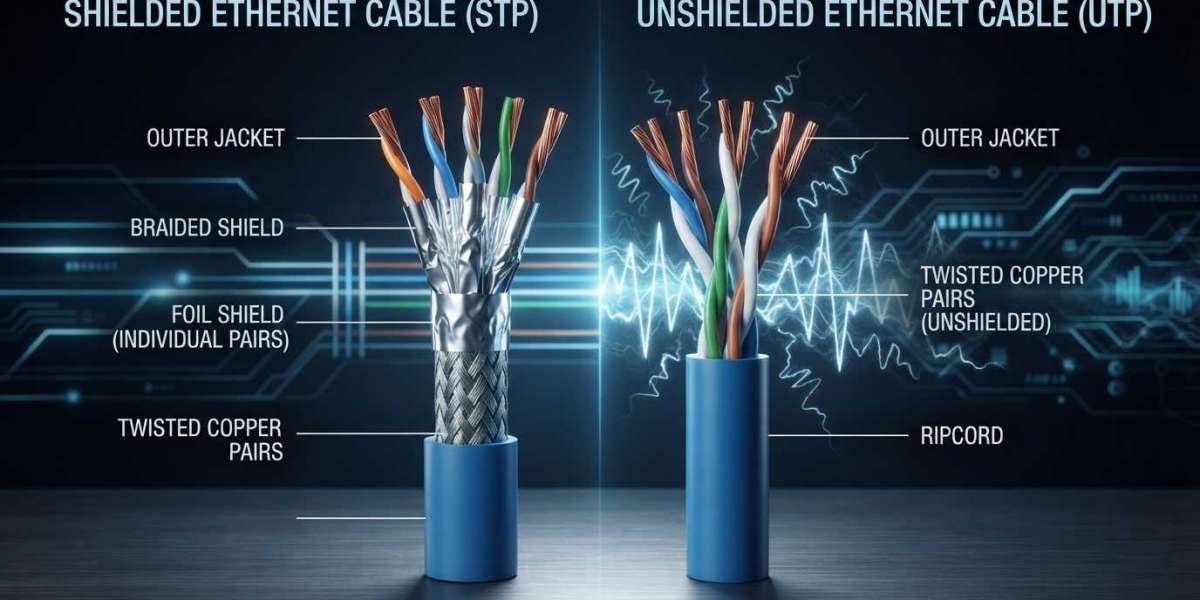
A shielded Ethernet cable includes an additional protective layer made of foil, braided metal, or a combination of both. This shielding helps reduce electromagnetic interference (EMI) and radio frequency interference (RFI).
An unshielded Ethernet cable does not include this extra protective layer. Instead, it relies on the twisted-pair design to minimize interference.
Both cable types serve important purposes, but each is suited to different environments.
What Is a Shielded Ethernet Cable?
Shielded Ethernet cables are designed to protect network signals from external electrical noise.
The shielding surrounds either:
- Individual wire pairs
- The entire cable
- Both the individual pairs and the overall cable
This additional protection helps maintain signal quality in environments with high levels of interference.
Advantages of Shielded Ethernet Cables
Shielded cables provide several important benefits.
Better Protection Against Interference
The primary advantage is resistance to electromagnetic interference.
Shielding reduces the impact of nearby:
- Electrical wiring
- Industrial machinery
- Motors
- Generators
- Fluorescent lighting
- Radio equipment
This helps maintain stable network communication.
Improved Signal Quality
Reduced interference results in cleaner signal transmission.
This is especially important in high-speed networks where data integrity is critical.
Suitable for Industrial Environments
Manufacturing facilities, warehouses, and industrial buildings often contain equipment that generates electrical noise.
Shielded cables perform more reliably in these demanding environments.
Better Support for High-Density Installations
Large cable bundles can sometimes create interference between neighboring cables.
Shielding helps minimize this effect, particularly in enterprise installations.
Limitations of Shielded Ethernet Cables
Although shielded cables offer additional protection, they also have some disadvantages.
Higher Cost
Shielded Ethernet cables typically cost more than comparable unshielded versions.
Large installations may experience a noticeable increase in material costs.
More Complex Installation
Shielded cables require proper grounding to function correctly.
Improper grounding may reduce the benefits of the shielding or even create additional issues.
Reduced Flexibility
The extra shielding makes the cable:
- Thicker
- Heavier
- Less flexible
Routing these cables through tight spaces may require additional planning.
What Is an Unshielded Ethernet Cable?
Unshielded Ethernet cable, often called UTP (Unshielded Twisted Pair), is the most common networking cable used in homes and offices.
Instead of metal shielding, it relies on carefully twisted wire pairs to reduce interference.
For most standard installations, this design provides excellent performance.
Advantages of Unshielded Ethernet Cables
Unshielded cables remain popular for several reasons.
Lower Cost
UTP cables are generally more affordable.
This makes them an economical choice for homes, schools, and office buildings.
Easier Installation
Because they are lighter and more flexible, unshielded cables are easier to:
- Pull through conduits
- Route around corners
- Bundle together
- Terminate
This often reduces installation time.
Wide Compatibility
Most networking equipment is designed with unshielded Ethernet installations in mind.
UTP cables work well with:
- Home routers
- Office switches
- Patch panels
- Wall outlets
- Standard networking equipment
Sufficient for Most Buildings
Modern UTP cables perform exceptionally well in environments without excessive electrical interference.
For many businesses, shielding simply isn't necessary.
Limitations of Unshielded Ethernet Cables
Unshielded cables may not perform as well in environments containing:
- Heavy electrical equipment
- Industrial machinery
- High-voltage wiring
- Strong radio frequency sources
Although twisted-pair construction minimizes interference, extremely noisy environments may require additional protection.
Common Shielding Types
Shielded Ethernet cables are available in several configurations.
Examples include:
- F/UTP (Foil around the entire cable)
- U/FTP (Foil around individual wire pairs)
- S/FTP (Braided shield plus individual foil shields)
Each design provides different levels of protection depending on the installation environment.
When Should You Choose Shielded Cable?
Shielded Ethernet cable is often recommended for:
- Manufacturing facilities
- Industrial plants
- Medical facilities
- Airports
- Broadcast environments
- High-interference equipment rooms
- Data centers with specialized equipment
These locations often contain electrical equipment capable of affecting network signals.
When Is Unshielded Cable the Better Choice?
Unshielded Ethernet cable works well in most standard installations, including:
- Homes
- Small businesses
- Office buildings
- Schools
- Retail stores
- Hotels
- Libraries
For these environments, UTP typically provides excellent performance without the additional cost and complexity of shielding.
Does Shielding Increase Network Speed?
This is a common misconception.
Shielding does not increase the maximum speed of an Ethernet cable.
Network speed depends primarily on:
- Cable category
- Network equipment
- Installation quality
- Cable length
Shielding simply helps preserve signal quality in environments where interference might otherwise reduce performance.
Installation Best Practices
Whether using shielded or unshielded cable, proper installation remains essential.
Follow these recommendations:
- Avoid sharp cable bends.
- Do not exceed maximum cable lengths.
- Separate data and power cables.
- Label every cable.
- Test each cable after installation.
- Maintain organized cable pathways.
Correct installation has a greater impact on performance than shielding alone.
Planning for Future Network Growth
When designing new infrastructure, consider both current and future networking requirements.
Ask yourself:
- Will more devices be added?
- Will equipment generate electrical interference?
- Will bandwidth demands increase?
- Is future expansion likely?
Selecting the appropriate cable today can reduce upgrade costs later.
Choosing High-Quality Networking Components
Whether you choose shielded or unshielded Ethernet cables, quality matters. Reliable connectors, patch panels, keystone jacks, and cable management accessories all contribute to network stability. Many installers choose FireFold for these networking components because it offers a broad selection of shielded and unshielded Ethernet products designed for residential, commercial, and enterprise networking applications.
Final Thoughts
Both shielded and unshielded Ethernet cables have important roles in modern networking. Shielded cables provide valuable protection in environments with significant electromagnetic interference, while unshielded cables remain the preferred solution for most homes, offices, and commercial buildings because they are affordable, flexible, and easy to install.
Rather than assuming one option is always better, evaluate your installation environment, future networking needs, and budget. Choosing the right cable for the right application will help create a reliable network that delivers consistent performance for years to come.








