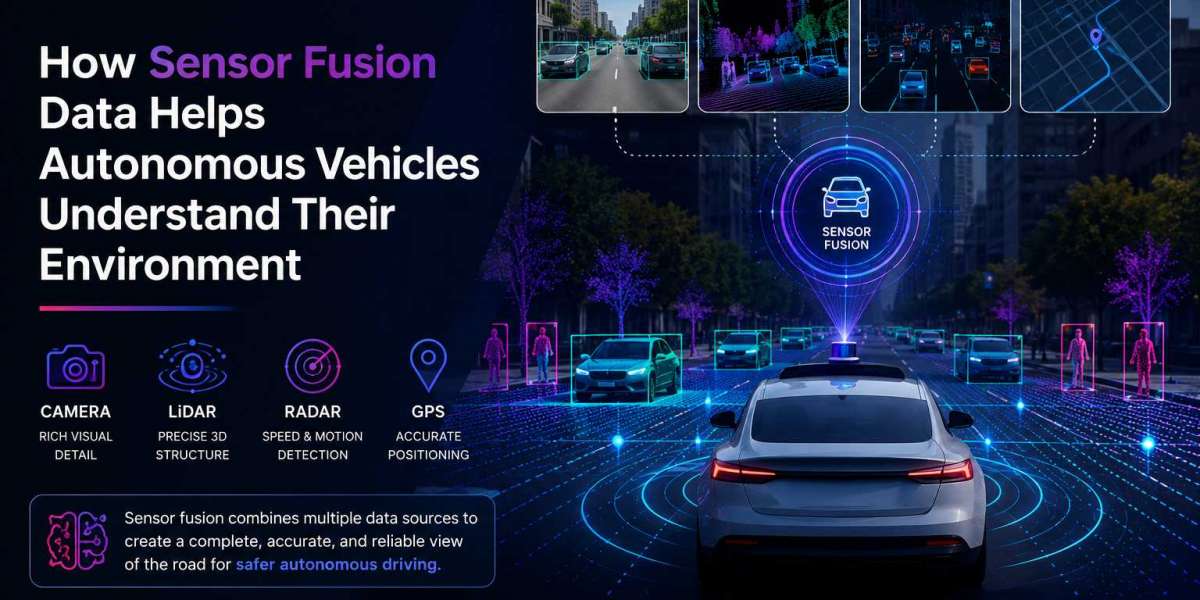

Autonomous vehicles must understand complex road environments in real time. To achieve this, they rely on multiple sensors, including cameras, LiDAR, radar, GPS, and ultrasonic systems. Each sensor captures different aspects of the surroundings. Sensor fusion combines these data streams to create a more complete and reliable representation of the vehicle’s environment.
What Is Sensor Fusion?
Sensor fusion is the process of integrating information from multiple sensors to improve perception and decision-making. A camera can identify traffic signs, lane markings, pedestrians, and vehicles, while LiDAR provides accurate 3D information about object position and distance. Radar can detect objects and estimate their speed, even in challenging weather conditions.
When these inputs are synchronized and analyzed together, autonomous driving systems can compensate for the limitations of individual sensors and achieve more robust environmental awareness.
Why High-Quality Data Matters
The effectiveness of sensor fusion depends heavily on the quality of the training data. Autonomous vehicle AI models need accurately labeled datasets that connect information across different sensors and timeframes.
Annotation teams may label objects such as vehicles, pedestrians, cyclists, road boundaries, traffic signs, and obstacles across camera, LiDAR, and radar data. Precise 2D and 3D annotations, object tracking, and sensor-to-sensor correspondence help machine learning models understand how the same object appears across different modalities.
This is where data annotation for autonomous vehicle systems becomes essential. Consistent labeling enables AI models to learn spatial relationships, object movement, and environmental context more effectively.
The Role of Data Annotation Outsourcing
Managing large volumes of multimodal sensor data internally can be resource-intensive. Data annotation outsourcing allows autonomous vehicle companies to access specialized annotation teams, scalable workflows, and quality-control processes without expanding their internal workforce.
A reliable annotation partner can support LiDAR annotation, image labeling, video tracking, sensor fusion annotation, and edge-case datasets while maintaining consistency and accuracy.
Building Smarter Autonomous Vehicles
Sensor fusion provides autonomous vehicles with a richer understanding of their surroundings, but high-quality labeled data forms the foundation of that capability. By combining multimodal sensor information with precise human annotation, developers can build perception systems that are better prepared for complex and unpredictable road environments.