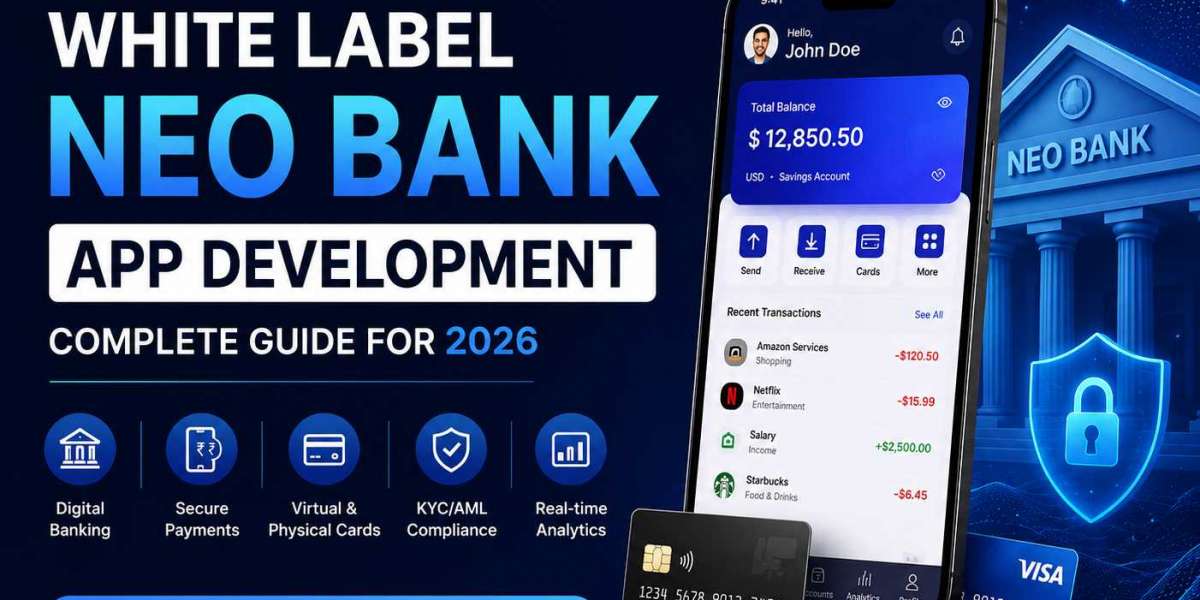

Digital banking is changing fast. Customers now expect simple onboarding, instant payments, mobile access, smart money management, and secure financial services from one app. This shift has created a strong opportunity for fintech startups, financial businesses, and entrepreneurs looking to launch their own digital banking products.
However, building a banking app from scratch can be complex. It requires strong technology, secure infrastructure, financial integrations, compliance workflows, and ongoing maintenance. This is where white label neo bank app development can offer a practical approach.
A white label neo bank solution gives businesses a ready technology foundation that can be customized with their own brand, design, features, and business model. Instead of spending years creating every component from zero, businesses can focus on their target market, customer experience, and growth.
What Is White Label Neo Bank App Development?
White label neo bank app development means creating a ready-made digital banking solution that a business can customize and launch under its own brand.
The platform can include features such as digital account management, money transfers, card management, payment processing, transaction tracking, KYC workflows, notifications, security tools, and administrative controls.
The exact banking services available depend on the market, regulatory model, banking partners, and financial infrastructure used by the business. A white label model does not remove regulatory responsibilities. Instead, it can reduce the amount of technology that needs to be built internally.
For startups, this approach can be useful because it allows them to enter the fintech market with a more focused development strategy.
Why Choose a White Label Neo Bank Solution in 2026?
Launching a digital banking product is no longer only about having a mobile app. Users expect a complete financial experience.
A modern platform should provide:
Fast digital onboarding
Secure account management
Digital and physical card support
Money transfers
Payment integrations
Transaction history
KYC and AML workflows
Real-time notifications
Fraud monitoring
Admin and reporting tools
API-based integrations
Scalable cloud infrastructure
Current 2026 development guides also emphasize KYC/AML, payments, cards, APIs, cloud architecture, security, and compliance as core areas of a modern neobank platform.
A white label approach can help businesses bring these components together while keeping their own branding and customer experience.
Key Features of a White Label Neo Bank App
The success of a banking app depends on the features offered to customers and administrators. Here are some of the most important features to consider.
1. Digital Account Creation
Users should be able to create and manage their accounts through a simple mobile onboarding process.
The registration flow can include:
Phone or email verification
Identity verification
Personal information
Document submission
Account approval
Profile management
The goal should be to make onboarding simple without compromising required compliance checks.
2. KYC and AML Integration
Compliance should be part of the product from the beginning.
KYC helps verify customer identity, while AML processes help identify suspicious financial activity. A neobank may connect with specialized verification and screening providers through APIs.
A strong onboarding system can also support manual review when automated verification fails.
This is especially important because compliance is one of the biggest challenges in financial technology development.
3. Digital Wallet and Account Management
Customers need an easy way to view balances, transactions, account details, and payment activity.
Useful account features include:
Balance overview
Transaction history
Account statements
Spending categories
Beneficiary management
Payment limits
Account settings
A clean dashboard can make complex financial information easier to understand.
4. Payment and Money Transfer
Payments are a core part of any digital banking product.
Depending on the target market, the platform may support:
Bank transfers
P2P payments
Scheduled payments
Recurring payments
Bill payments
Domestic transfers
Cross-border payments
Multi-currency transactions
Payment features should be connected through reliable and secure financial APIs.
5. Card Management
Modern users expect control over their cards directly from their phones.
A white label neo bank app can provide features such as:
Virtual cards
Physical cards
Card activation
Card freezing
Spending limits
PIN management
Transaction alerts
Card replacement requests
Card functionality can be connected with appropriate issuing and processing partners based on the business model and target country.
6. Transaction Notifications
Real-time notifications can improve transparency and customer trust.
Users can receive alerts for:
Payments
Transfers
Card transactions
Deposits
Withdrawals
Login activity
Security events
Push notifications can also help customers detect unusual activity quickly.
7. Security and Fraud Monitoring
Security is not an optional feature for financial applications.
A robust platform can use:
Multi-factor authentication
Encryption
Secure API communication
Device verification
Session management
Transaction monitoring
Risk-based controls
Fraud detection tools
Security architecture should be planned before launch rather than added after the application is already live.
Admin Panel for Business Owners
A powerful admin dashboard is just as important as the customer application.
Administrators may need access to:
Customer management
Account monitoring
Transaction monitoring
KYC status
Compliance reports
Payment records
Card management
Support tickets
Analytics
Notifications
Role-based permissions
An admin panel gives the business better visibility into daily operations and customer activity.
How Does White Label Neo Bank App Development Work?
The development process usually starts with business planning.
Step 1: Define the Business Model
First, identify the target audience and financial services you want to offer.
For example, your platform could target:
Consumers
Freelancers
Small businesses
Migrant workers
Students
E-commerce sellers
Specific professional communities
The target audience determines the feature roadmap.
Step 2: Select the Technology and Banking Infrastructure
The next step is choosing the technical architecture and financial partners.
Depending on the market, a business may work with banking partners, payment providers, card issuers, KYC providers, or Banking-as-a-Service infrastructure.
A white label solution can provide the application layer while external financial infrastructure handles specific regulated services.
Step 3: Customize the Application
This is where the white label platform becomes your product.
Customization can include:
Logo
Brand colors
UI/UX
App name
Dashboard
Features
User flows
Notifications
Business rules
The goal is to make the application feel like a unique banking product rather than a generic template.
Step 4: Integrate Financial APIs
APIs connect the application with external financial services.
Depending on the product, integrations may include:
Banking APIs
Payment gateways
KYC providers
AML screening
Card issuing services
Currency exchange
Identity verification
Notification services
API-first architecture is widely used because it makes financial services easier to connect and update as the business grows.
Step 5: Testing and Security
Before launch, the application should go through functional, performance, security, API, and usability testing.
Financial applications cannot afford unreliable transactions or weak authentication.
Testing should cover both normal customer journeys and unusual scenarios such as failed payments, rejected KYC checks, duplicate transactions, and account recovery.
Step 6: Launch and Scale
Once testing is complete, the application can be prepared for deployment.
After launch, the development team can monitor:
App performance
Customer feedback
Transaction issues
Security events
API performance
Server capacity
Feature usage
Continuous improvements help the platform remain competitive.
White Label vs Custom App Development
Businesses often ask whether they should choose a white label product or build everything from scratch.
Custom development gives you maximum control, but it can require more time, development resources, testing, and maintenance.
A white label solution can provide a faster starting point and reduce the amount of repetitive development work.
The right option depends on your budget, business model, target market, customization needs, and long-term product strategy.
What Can Other Clone App Models Teach Fintech Businesses?
The same ready-made development model is used across many digital industries.
For example, an amazon clone app can provide a ready foundation for an eCommerce marketplace. The business can then customize the design, product categories, seller features, payments, and customer experience.
Similarly, a doordash clone app can provide the core technology for a food delivery marketplace, including customer ordering, restaurant management, delivery tracking, payments, and admin controls.
The business idea is similar: use a proven technology foundation, customize it for a specific market, and focus development resources on differentiation.
For fintech, however, there is an additional layer of complexity because banking products involve financial regulations, identity verification, security, payment infrastructure, and partner dependencies.
How Much Does White Label Neo Bank App Development Cost?
There is no single price for a white label neobank because every project has different requirements.
The overall investment can depend on:
Number of features
UI/UX customization
Banking integrations
Payment integrations
KYC/AML integrations
Card infrastructure
Security requirements
Admin panel complexity
Supported countries
Number of platforms
Third-party services
Ongoing maintenance
Some 2026 industry estimates place white-label neobank projects in a broad range from tens of thousands of dollars upward, depending heavily on customization and integrations.
Instead of selecting a vendor based only on the lowest price, businesses should evaluate the technology, security, integration experience, scalability, support, and ownership terms.
Benefits of White Label Neo Bank App Development
There are several reasons businesses consider this model.
Faster Market Entry
Ready-made components can reduce the amount of development required before launch.
Lower Initial Development Effort
Businesses do not need to recreate every common banking component from the ground up.
Better Customization
A good white label solution can be adapted to the company's branding and customer requirements.
Scalable Architecture
The platform can be designed to support additional users, services, and integrations as the business grows.
Focus on Business Growth
Instead of spending all resources on basic infrastructure, the business can focus more on customer acquisition, partnerships, marketing, and product differentiation.
How to Choose the Right Development Company
Choosing the right development partner can have a major impact on the success of a fintech project.
Before selecting a white label neo bank app development company, ask:
Does the company understand fintech applications?
Can the platform integrate with external APIs?
Is the source code available?
Can the application be fully branded?
What security practices are followed?
How is scalability handled?
What support is provided after launch?
Can new features be added later?
How are third-party integrations managed?
Also ask for a clear project scope before development begins. A detailed scope can prevent unexpected costs and delays.
Why CloneAppz for White Label Neo Bank App Development?
Businesses looking for a ready technology foundation can consider CloneAppz for their digital banking product.
The focus should not only be on launching an app. A successful fintech product needs a strong combination of user experience, secure technology, integrations, scalability, and ongoing development.
With the right white label approach, businesses can customize their banking platform around their brand and target customers while building a roadmap for future growth.
Whether you are planning a consumer banking app, a business finance platform, or a specialized fintech product, the technology should be flexible enough to evolve with your business.
Final Thoughts
White label neo bank app development can be a practical route for startups, entrepreneurs, and established businesses that want to enter the growing digital banking space without creating every technology component from scratch.
The most important part is not simply launching quickly. The platform must be secure, scalable, easy to use, and designed around the financial requirements of the target market.
From digital onboarding and KYC to payments, cards, account management, APIs, security, and analytics, every component plays a role in building customer trust.
The same ready-made approach that supports an amazon clone app or doordash clone app can help businesses start with a strong technology foundation. But fintech requires extra attention to compliance, financial integrations, security, and operational reliability.
If you have a clear fintech idea and want to turn it into a branded digital banking product, choosing the right development partner can make the journey faster and more manageable.