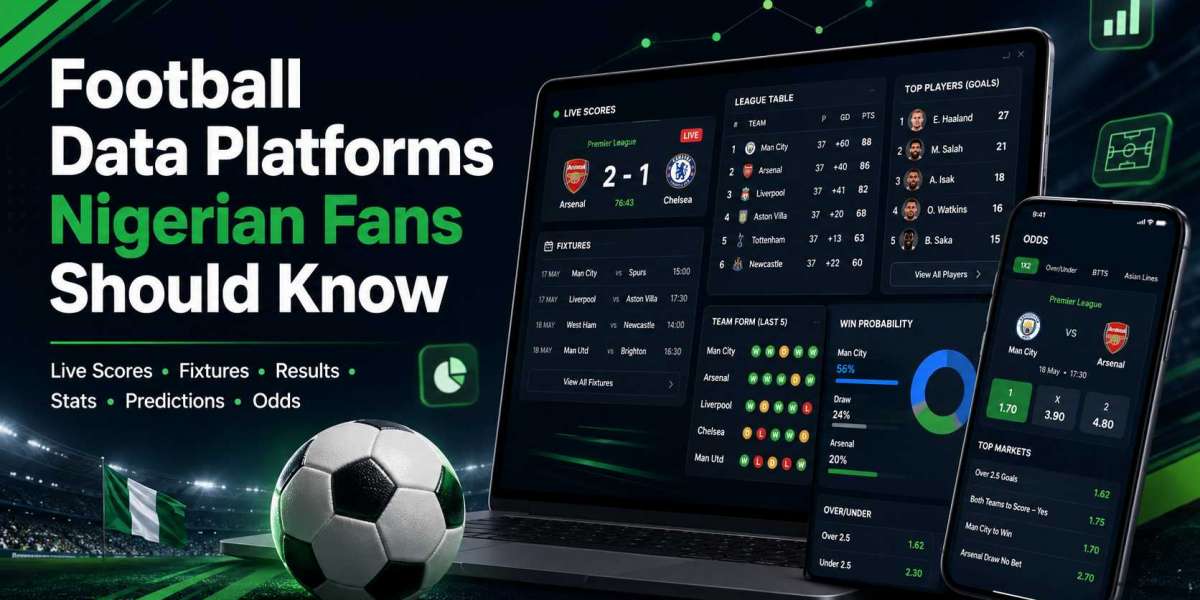

Following football today involves far more than checking the final score.
A Nigerian fan watching the Premier League may want to know Manchester United's next fixture, Arsenal's recent form, the current league table, a player's season statistics or how a prediction model assesses an upcoming Champions League match. During a busy weekend, the same supporter might also be following matches in La Liga, Serie A, the Bundesliga and international competitions.
Football data platforms make this possible by organising large amounts of match information into something fans can actually use.
But there is an important distinction: not every football data platform is designed for the same purpose.
Some are built primarily for live scores. Others specialise in statistics, results, tables, predictions or betting-market information. Knowing which type of platform to use—and how to interpret its data—can make football research considerably more useful.
What Exactly Is a Football Data Platform?
A football data platform is an online service that collects, processes and presents information about football matches, competitions, teams and players.
Depending on the platform, that information may include:
today's football fixtures;
live scores;
completed results;
league standings;
match statistics;
team form;
player records;
line-ups;
goals and cards;
home and away records;
head-to-head information;
football predictions;
probability estimates;
betting odds.
Some platforms concentrate on one area, while others combine several types of football information.
The right platform therefore depends on the question you are trying to answer.
1. Live Score Platforms for Following Matches in Real Time
For many fans, live score websites are the most frequently used form of football data platform.
They become particularly valuable when several matches are being played at the same time.
Imagine a Saturday afternoon with Premier League, Bundesliga, La Liga and Serie A fixtures overlapping. Watching every game is impossible, but a live football platform can allow users to follow several matches from one screen.
Useful live-match information may include:
current score;
match minute;
halftime and full-time status;
goalscorers;
cards;
substitutions;
line-ups;
basic match statistics.
For Nigerian supporters who are travelling, working or unable to access a broadcast, this type of platform provides a practical way to remain connected to the action.
What Should You Look For?
Speed and clarity matter most.
A live score platform loses much of its usefulness if a goal has already happened but the displayed score remains unchanged for several minutes.
Good live football data should be easy to scan without overwhelming users with unnecessary information.
2. Fixtures Platforms for Planning Matchday
Football fans do not only need data once a match begins.
Sometimes the most important question is simply:
What matches are being played today?
Fixtures platforms help organise upcoming games by date, league or team.
A useful fixture page can answer questions such as:
When does Chelsea play next?
Which Premier League games are scheduled today?
What Champions League fixtures are coming this week?
When is Real Madrid's next match?
Which matches are scheduled tomorrow?
For supporters following multiple competitions, having a central football calendar saves considerable time.
This becomes especially useful during periods when league matches, domestic cups, European football and international fixtures overlap.
3. Football Results Databases
Results platforms perform a different job.
Instead of showing what is about to happen, they record what has already happened.
That may sound straightforward, but historical results become valuable when assessing a team's current performance.
A fan researching an upcoming fixture might want to check:
the team's last five matches;
recent home results;
recent away results;
goals scored;
goals conceded;
results against similar opposition.
The result itself is only the beginning.
A run of four consecutive victories can appear impressive until you discover that all four came against teams near the bottom of the table.
Football data becomes more useful when it is interpreted in context.
4. League Table and Standings Platforms
The league table remains one of football's most important datasets.
Standings normally show information such as:
| Data | What It Shows |
|---|---|
| Played | Number of league matches completed |
| Wins | Matches won |
| Draws | Matches drawn |
| Losses | Matches lost |
| GF | Goals scored |
| GA | Goals conceded |
| GD | Goal difference |
| Points | Current league points |
The table tells fans where a team stands within the competition.
However, position alone does not explain everything.
A team sitting fifth could currently be in excellent form, while a second-placed side may have started losing matches.
This is why standings work best when combined with recent results and performance data.
5. Team Statistics Platforms
Statistics platforms allow supporters to go deeper than results.
Instead of simply showing that a team won 2-1, they can provide information that helps explain how the match developed.
Depending on the data provider, users may encounter metrics such as:
possession;
shots;
shots on target;
corners;
passing;
fouls;
cards;
goals scored per match;
goals conceded per match;
clean sheets.
These statistics can reveal important differences between teams with superficially similar records.
Imagine two clubs have both won three of their previous five matches.
Team A consistently creates large numbers of chances.
Team B has won several close matches despite producing relatively little attacking pressure.
The results are similar, but the performance profiles are different.
That distinction may matter when analysing what could happen next.
6. Player Data Platforms
Football research is not limited to teams.
Player data can help supporters follow individual performances across a season.
Depending on the platform, player pages may include:
appearances;
starts;
minutes played;
goals;
assists;
cards;
transfers;
squad information;
season statistics.
This information becomes particularly useful when evaluating the importance of a particular player to a team.
For example, knowing that a striker has scored 15 goals is useful.
Knowing that those goals came across 18 starts and that the player has recently missed several matches provides considerably more context.
7. Football Prediction Platforms
Prediction platforms approach football data differently.
Rather than simply recording past events, they use available information to estimate possible future outcomes.
A prediction might be presented as:
Home Win: 47%
Draw: 30%
Away Win: 23%
These percentages should not be interpreted as promises.
They represent estimates.
The home team has the highest predicted probability in this example, but there is still a combined 53% probability assigned to outcomes other than the home victory.
This is an important distinction for anyone using football predictions.
NaijaScore9 provides a dedicated football prediction platform where Nigerian fans can explore available match predictions as part of their wider pre-match research.
The most sensible use of predictions is to combine them with other relevant football information rather than relying on a percentage alone.
8. Odds and Market Data Platforms
Football odds are another useful form of data.
Although they are commonly associated with betting, odds can also be interpreted as market probabilities.
For example:
Decimal odds: 2.00
The approximate implied probability is:
1 ÷ 2.00 × 100 = 50%
At odds of 1.50:
1 ÷ 1.50 × 100 ≈ 66.7%
Understanding this relationship can help users compare a football prediction with the price available in the betting market.
Suppose a model estimates a home victory at 58%, while a bookmaker price implies 50%.
That difference may be worth investigating.
It is not evidence that the bet will win.
The reliability of the prediction, bookmaker margin and current team information all still matter.
9. Why One Platform May Not Be Enough
Football fans sometimes search for one website that can answer every possible question.
That is not always necessary.
Different platforms may be stronger at different tasks.
You might use:
one service for live scores;
another for detailed player statistics;
a prediction platform for pre-match probabilities;
an odds tool for understanding market prices.
What matters is whether the information is reliable, relevant and clearly presented.
The objective should not be collecting as much data as possible.
It should be finding the right data for the question you are asking.
How Nigerian Fans Can Judge the Quality of Football Data
Having thousands of statistics on a page does not automatically make a platform useful.
Several qualities matter more.
Data Freshness
Football information changes quickly.
A platform showing an outdated league table, old fixture time or incorrect match status can create confusion.
Freshness is particularly important for:
live scores;
match status;
team line-ups;
fixtures;
tables.
Competition Coverage
Nigerian fans follow football across many regions.
Popular interests include English football and UEFA competitions, but substantial audiences also follow Spanish, Italian, German, French, African and international football.
A useful platform should cover the competitions relevant to its audience.
Mobile Usability
Many fans check football data on phones.
Match information should therefore remain understandable on smaller screens.
Important information should not require excessive scrolling, zooming or navigating through unnecessary pages.
Clear Presentation
More data is not always better.
A well-organised page showing six useful statistics may be more valuable than one containing 60 numbers without explanation.
Do Not Confuse Data With Conclusions
This is one of the most important principles in football analysis.
A statistic is evidence.
It is not automatically a conclusion.
Suppose a team has won five consecutive matches.
That is data.
It does not automatically mean:
This team will win its next match.
You still need to ask:
Who did they beat?
Where were those matches played?
What was the quality of the performances?
Who is the next opponent?
Are important players available?
The same principle applies to almost every football statistic.
Be Careful With Head-to-Head Records
Head-to-head data often receives too much attention.
Imagine Arsenal and Chelsea played four years ago.
Since then, both clubs may have changed:
managers;
players;
tactical systems;
recruitment strategies;
competitive level.
The old result is historically accurate, but its predictive usefulness may be limited.
Recent meetings can still add context, but head-to-head records should rarely override more relevant information about the teams today.
Separate Team Form From Opposition Quality
Five wins do not always equal five strong performances.
Consider two hypothetical teams.
Team A: five wins against clubs ranked near the bottom.
Team B: three wins, one draw and one defeat against several title contenders.
A simple form table makes Team A look stronger.
Context may suggest otherwise.
Good football data users therefore ask both:
What happened?
and
Against whom did it happen?
How Football Data Can Improve Pre-Match Research
A structured approach can prevent users from jumping between random statistics.
Before an upcoming match, you could check:
Step 1: The Fixture
Confirm the competition, venue and kickoff information.
Step 2: League Position
Understand where each team currently sits.
Step 3: Recent Results
Review the latest performances rather than relying only on season-long records.
Step 4: Home and Away Data
Some teams perform very differently depending on venue.
Step 5: Scoring and Defensive Records
Look at how consistently each team scores and concedes.
Step 6: Team Information
Consider injuries, suspensions and relevant squad changes where available.
Step 7: Predictions
Review probability-based analysis without interpreting it as certainty.
Step 8: Market Data
If odds are relevant to you, compare the market's implied probabilities with the wider analysis.
This approach gives each piece of information a purpose.
Where NaijaScore9 Fits Into Football Research
NaijaScore9 focuses on football predictions, odds, betting analysis and tools that help users interpret football markets.
Instead of treating a prediction as a guaranteed outcome, fans can use the platform as one part of a broader research process.
Through NaijaScore9, users can move between prediction-related information, odds content, betting guides and analytical tools depending on what they are trying to understand.
That distinction matters.
A football platform should ideally help users make sense of information rather than encourage them to blindly follow a number.
More Data Does Not Guarantee a Better Prediction
Modern football platforms can provide enormous amounts of information.
Yet football remains unpredictable.
A team can dominate possession and lose.
A striker can miss several clear chances.
A red card can completely alter a match.
An underdog can score from its only meaningful opportunity.
Data helps describe probabilities and patterns.
It does not eliminate uncertainty.
The strongest way to use football data is therefore to improve understanding—not to search for certainty that does not exist.
Final Thoughts
Football data platforms give Nigerian fans access to information that was once difficult to obtain.
Live score platforms can track matches minute by minute. Fixture and results databases organise the football calendar. League tables show competitive position. Team and player statistics reveal deeper performance patterns, while prediction and odds platforms help users explore probabilities before kickoff.
The important skill is knowing which data matters for the question being asked.
Do not judge a team from one result. Do not treat an old head-to-head record as decisive. Do not interpret a prediction percentage as a guarantee.
Instead, combine reliable information with context.
When fixtures, form, standings, statistics, predictions and market information are interpreted together, football data becomes much more useful—not because it tells fans exactly what will happen next, but because it helps them understand the match more clearly before it begins.








