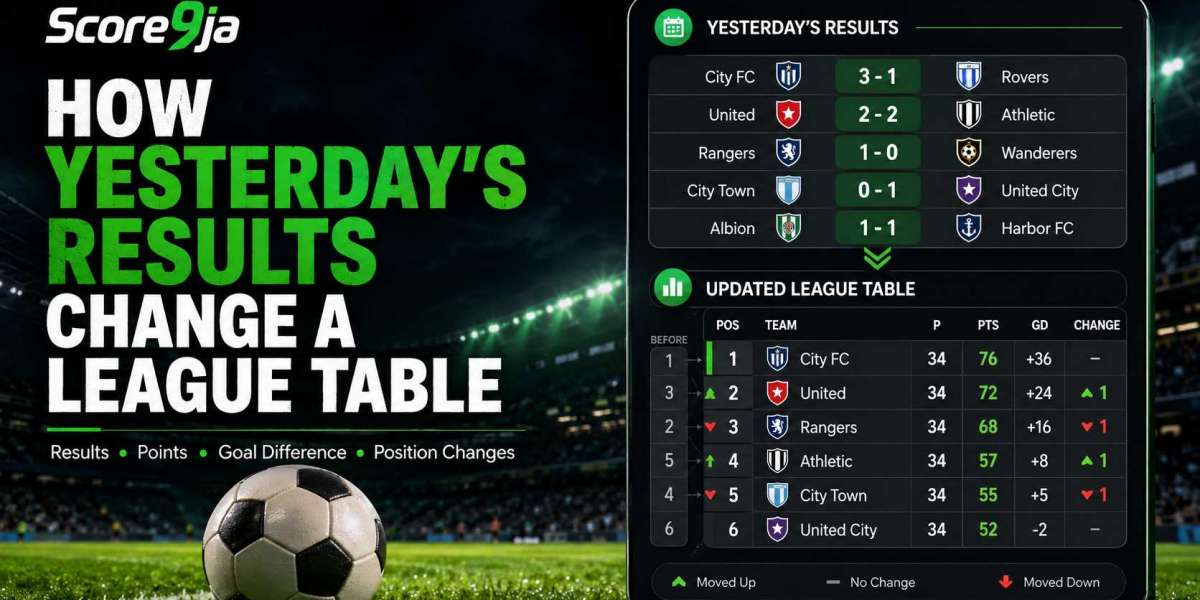

How Yesterday's Results Can Change a League Table
A football league table can look very different after just one matchday.
A team that was sitting in third place yesterday might move into second after winning, while another club can drop several positions after losing. Near the bottom of the table, one victory may be enough to move a team out of the relegation zone.
This is why checking yesterday's football results can be just as important as looking at today's fixtures.
Results do not simply tell you who won and lost. They change points totals, goal difference, league position and sometimes the entire shape of a title race, qualification battle or relegation fight.
Here is how yesterday's matches can affect a league table.
Start With Yesterday's Football Results
The first step is to review the matches that were completed the previous day.
Fans can check yesterday's football results on Score9ja to see completed matches across supported competitions before looking at how those outcomes affected the standings.
A useful results page helps you identify:
teams that won;
matches that ended in draws;
teams that lost;
final scores;
competition;
completed match status.
Once the results are clear, the league table becomes much easier to understand.
A Win Can Move a Team Several Places
In most league competitions, a win is worth three points.
That may not sound dramatic, but three points can make a major difference when several teams are close together.
Imagine the table looks like this before a matchday:
Team A – 45 points
Team B – 43 points
Team C – 42 points
Team D – 41 points
If Team D wins and the teams above it all drop points, Team D could suddenly move much closer to the top.
This happens frequently during competitive league seasons where only a few points separate several clubs.
That is why a single result can produce noticeable movement in the standings.
Draws Can Help One Team and Hurt Another
A draw normally gives each team one point.
Whether that is a good result depends on the wider situation.
Suppose a team chasing the league title draws against a lower-ranked opponent.
It gains one point, but if its title rival wins, the gap between them increases.
The same draw might be valuable for a relegation-threatened team trying to collect every possible point.
So the result itself does not tell the whole story.
The league table shows whether the point gained actually improved the club's position.
Goal Difference Can Decide Positions
Sometimes two teams finish a matchday with the same number of points.
In these situations, goal difference can become important.
Goal difference is calculated using the difference between goals scored and goals conceded.
For example:
Team A: 35 goals scored, 20 conceded = +15
Team B: 32 goals scored, 20 conceded = +12
If both teams have the same points total, Team A may be ranked higher because of the better goal difference, depending on the competition's rules.
This means yesterday's scoreline matters beyond the win itself.
A 4-0 victory can potentially have a greater effect on goal difference than a 1-0 win.
Likewise, a heavy defeat can damage a team's position even if another club has the same number of points.
Yesterday's Results Can Change a Title Race
At the top of the table, one evening of football can completely change the title picture.
Imagine the league leaders lose while the second-placed team wins.
A five-point gap could suddenly become two points.
If both teams are playing frequently, the standings can continue changing from week to week.
This is why supporters following a title race often check both their own team's result and the scores involving direct rivals.
Looking at football league tables after the matches have finished gives the result proper context.
The score tells you what happened.
The standings tell you what it means.
European Qualification Positions Can Change Quickly
In many leagues, several teams compete for qualification places throughout the season.
The difference between fourth, fifth and sixth position may be only one or two points.
If two clubs win while another loses, the order can change immediately.
This makes yesterday's results especially important when the league reaches the final third of the season.
A supporter may wake up expecting their club to remain in fourth position, only to find that a rival's late win moved them above it.
Checking updated standings prevents you from relying on an outdated version of the table.
Relegation Battles Can Change Overnight
Movement at the bottom of a league can be even more dramatic.
Teams fighting relegation are often separated by very small margins.
Imagine:
Club A – 28 points
Club B – 27 points
Club C – 26 points
If Club C wins while Clubs A and B lose, Club C could move above both teams.
One result can therefore move a team from the relegation zone to safety.
This is why supporters following struggling clubs should not only look at their own team's score.
Results from nearby teams can be just as important.
Games in Hand Can Make the Table Misleading
A league table should always be read alongside the number of matches played.
Two teams may have different points totals simply because one has played fewer games.
For example:
Team A: 50 points from 25 matches
Team B: 47 points from 23 matches
Team A is ahead in the current standings, but Team B has two games in hand.
Yesterday's results may reduce or increase this imbalance.
When postponed matches are eventually played, the table can change again even if most other teams are not involved.
Always check both points and matches played before drawing conclusions.
Head-to-Head Results Can Matter Too
In some competitions, teams level on points may be separated using head-to-head records or other tie-break rules.
That means yesterday's result against a direct rival can have additional significance.
A victory may provide three points while also improving the club's position in a relevant tie-break situation.
The exact rules vary between competitions, but the principle is the same:
Not every three-point win has exactly the same impact.
The opponent and competition context matter.
Several Results Together Create the Biggest Changes
The largest table movements usually happen when several matches combine.
Suppose your club wins.
That is useful.
But if the three teams directly above it also win, the position may remain unchanged.
Now imagine your club wins while all three rivals lose.
The same three points could suddenly move your team several places higher.
This is why a full matchday view is more informative than checking only one score.
Football supporters can use Score9ja football results to review completed matches together and then compare those outcomes with the latest league positions.
Check the Table After All Matches Finish
During a matchday, league positions can temporarily change.
A club playing earlier may move to the top of the table, only to drop back down when another team wins later.
This is sometimes described as a live or provisional table.
For a clearer picture, check the standings after the relevant round of matches has finished.
That gives you the confirmed points totals based on all completed games.
The process is simple:
Yesterday's Results → Updated Points → New Goal Difference → Revised League Positions
Following that sequence helps explain why the table looks different from the previous day.
Use Results and Tables Together
Looking at results without standings can make it difficult to judge importance.
Looking at a table without knowing the latest results can make the movement seem confusing.
The two should be used together.
A practical routine is:
Check yesterday's completed matches.
Identify results involving your team and direct rivals.
Review the updated league table.
Compare points and matches played.
Look at goal difference if teams are level.
Check the next fixtures to see what could change again.
This gives you a much better understanding of how the competition is developing.
Final Thoughts
Yesterday's football results can change a league table dramatically, especially when teams are separated by only a few points.
Wins can move clubs higher, defeats can cause sudden drops and draws can become more or less valuable depending on what direct rivals do.
Goal difference, matches played and competition tie-break rules can also influence the final order.
Instead of looking only at individual scores, compare completed matches with the updated standings.
Score9ja brings football results and league information together so fans can see not only what happened yesterday, but also how those results changed the wider competition.