
Introduction
Cooling a large industrial or commercial space is not as simple as placing a few air-conditioning units around the building. Large workshops, warehouses, production areas, garages, and open workspaces often have high heat loads, continuous fresh-air requirements, and large floor areas to cover. This is where evaporative coolers can offer a practical alternative to conventional refrigeration-based cooling, particularly in hot and relatively dry conditions.
Instead of relying on a compressor and refrigerant cycle, evaporative cooling uses the natural process of water evaporation. Warm air passes through wetted cooling media, where some of the water evaporates and absorbs heat from the airstream. The resulting air is cooler and can then be distributed directly into the occupied area or through ductwork.
However, good performance depends on more than the cooler itself. Climate, ventilation, airflow, cooling-pad condition, installation, water quality, and the construction of the equipment all influence the final result. For industrial environments, choosing a suitably engineered unit can make a significant difference to reliability and long-term operating performance.
How Evaporative Coolers Actually Work
The operating principle behind evaporative cooling is straightforward. A fan or blower draws warm ambient air toward water-saturated cooling pads. As the air moves through the wet media, a portion of the water changes from liquid to vapour. That evaporation absorbs sensible heat from the air, reducing its dry-bulb temperature before the cooled air is delivered into the space.
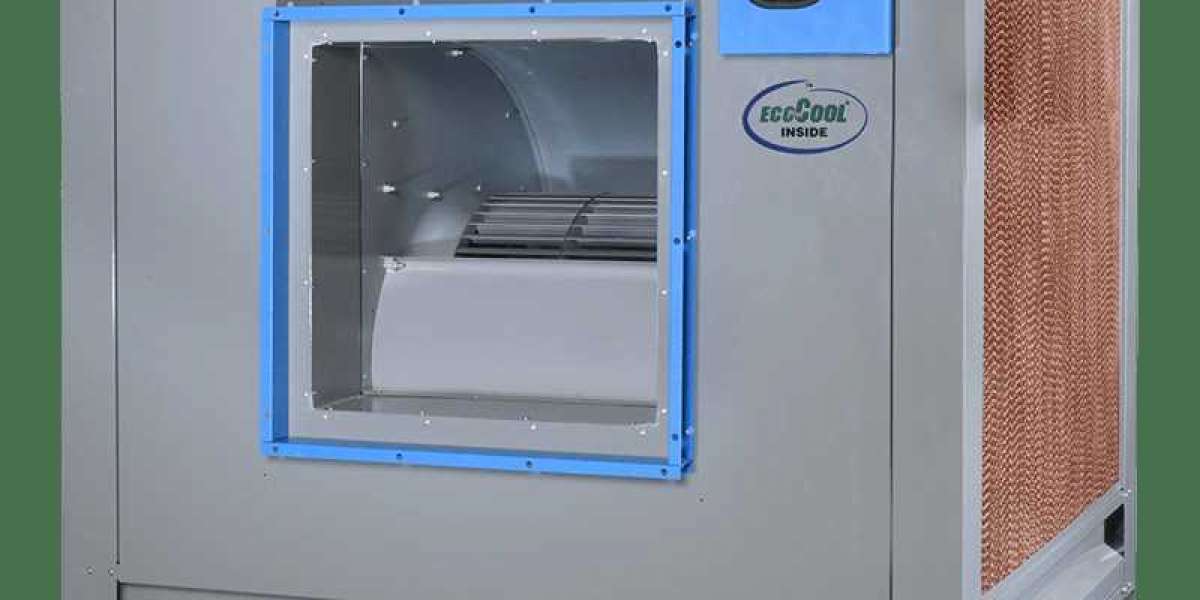
A typical system therefore includes several essential components: a water reservoir or sump, pump, water distribution arrangement, cooling media, fan or blower, motor, and control system. The pump continuously distributes water over the cooling pads while the fan maintains the airflow needed for evaporation. The quality and design of these components affect airflow, cooling effectiveness, water consumption, and maintenance requirements.
One important point is often misunderstood. Direct evaporative cooling does not work like a conventional air conditioner. The process adds moisture to the supply air because the air comes into direct contact with evaporating water. Consequently, its performance is closely related to the entering air's humidity and wet-bulb temperature.
This is why evaporative cooling tends to perform particularly well in hot, dry climates. When the incoming air has relatively low moisture content, it has greater capacity to absorb additional water vapour. In humid conditions, that evaporation potential becomes smaller, so the achievable temperature reduction also decreases.
Direct and Indirect Evaporative Cooling Explained
Not all evaporative coolers use exactly the same cooling process. Direct evaporative cooling is the simplest arrangement. Outside air passes directly through wetted media and leaves the cooler at a lower temperature but with increased moisture content. This approach can be highly effective where climate conditions are favourable and where adding some humidity is acceptable.
Indirect evaporative cooling takes a different approach. A heat exchanger separates the primary supply airstream from the evaporatively cooled secondary airstream. Heat is transferred without directly adding the evaporated moisture to the air delivered into the occupied area. This makes indirect systems useful when humidity control is important.
There are also two-stage and indirect-direct systems that combine both methods. In these arrangements, air can first be pre-cooled indirectly and then receive additional direct evaporative cooling. The result can be greater cooling potential than a single-stage arrangement, while offering more control over humidity.
The choice between direct, indirect, and combined systems should therefore be based on the actual application rather than simply the maximum temperature reduction advertised for a particular unit. A manufacturing facility, warehouse, workshop, office, and process area may all have very different requirements.
Why Climate and Ventilation Matter So Much
Climate is one of the most important factors when evaluating evaporative cooling. The cooling potential is fundamentally linked to the difference between the entering air's dry-bulb and wet-bulb temperatures. A larger difference generally means more opportunity for evaporation and therefore greater cooling potential.
In hot and dry regions, evaporative cooling can provide substantial comfort and space-cooling benefits while using considerably less electrical energy than conventional compressor-based air conditioning in suitable applications. Research examining Indian climates has also found significant energy-saving potential for indirect evaporative cooling under appropriate conditions.
Ventilation is equally important. Direct evaporative systems continuously introduce cooled outdoor air into a space. That air needs an exit path. If a room is completely sealed, moisture can accumulate and the cooling process becomes progressively less effective. Openings, exhaust systems, doors, windows, or suitable ventilation arrangements help maintain the required air movement.
This requirement is particularly relevant in industrial buildings. Large workshops and production floors often have doors, roof vents, exhaust systems, or other openings naturally suited to the fresh-air principle of evaporative cooling. Instead of attempting to condition every cubic metre of air in a tightly sealed building, the system can provide a continuous flow of cooler outdoor air through the occupied zone.
Selecting the Right Cooler for Industrial Applications
Industrial cooling requires more careful selection than simply matching a cooler to the floor area. Air delivery is one of the first specifications to consider. The system must move sufficient air to meet the required air changes and distribute cooling where people or processes actually need it. Building guidance recommends evaluating required airflow, installation location, energy consumption, maintenance access, noise, controls, and durability when selecting an evaporative cooling system.
The physical layout of the building matters as well. A large open workshop may be suitable for free-flow cooling, while a facility with separate work zones may benefit from a ducted arrangement. Ducting can direct air to specific areas and provide more controlled air distribution, especially where equipment, machinery, or building geometry creates uneven heat loads.
Construction quality should also receive attention. Industrial environments can expose cooling equipment to dust, vibration, moisture, heat, and continuous operation. A robust metal enclosure can be preferable where mechanical durability is important. For example, Arctic Air Coolers offers industrial evaporative cooling equipment using pre-coated steel construction on certain ducted models, along with centrifugal blowers designed for higher static-pressure applications.
Motor and blower selection should match the required airflow and pressure. A cooler that moves plenty of air under free-flow conditions may not perform adequately when connected to long ducts, multiple grilles, filters, or other airflow restrictions. Proper system design therefore matters just as much as the nominal cooling capacity of the unit.
Cooling Pads, Water Quality and Maintenance
Cooling media is one of the most important working parts of an evaporative cooler. The pad provides the surface over which water and air interact, so its structure, thickness, saturation, cleanliness, and condition all affect evaporation. Research comparing common evaporative cooling media has found differences in cooling performance and energy efficiency depending on the pad material used.
Water quality deserves equal attention. As water evaporates, dissolved minerals can remain behind and gradually form deposits on cooling pads, pumps, water lines, and tanks. Dust and airborne contaminants can create additional buildup. If the media becomes clogged or water distribution becomes uneven, airflow and evaporation can suffer.
Routine maintenance should therefore include inspection and cleaning of the water reservoir, pump, distribution system, cooling media, fan or blower, and associated components. Industry guidance also stresses the importance of keeping the water reservoir clean because evaporative cooling systems continuously operate with water.
Maintenance frequency depends on operating conditions. A dusty factory operating for long hours may require more frequent attention than a lightly used commercial space. Hard-water conditions can also accelerate scale formation. Rather than following an arbitrary maintenance calendar, operators should monitor water quality, pad condition, airflow, odour, pump performance, and visible deposits and service the equipment accordingly.
Energy Efficiency Without Ignoring Water Consumption
One of the strongest reasons businesses consider evaporative cooling is energy efficiency. Because the primary cooling mechanism is evaporation rather than a compressor-driven refrigeration cycle, electrical demand can be substantially lower in suitable climates. The U.S. Department of Energy notes that evaporative coolers can use substantially less energy than central air conditioning in dry climates, while also emphasizing the need for regular maintenance.
Studies of indirect evaporative cooling in Indian climates have also demonstrated meaningful reductions in power requirements compared with conventional air conditioning under selected operating conditions. One analysis found that an indirect evaporative cooler required roughly 55% less power than a conventional air conditioner for comparable cooling under the studied conditions.
That does not mean evaporative cooling is automatically the most economical choice in every building. Water consumption is another operating consideration. The amount of water used depends on factors such as ambient conditions, airflow, operating hours, cooling load, system efficiency, bleed-off requirements, and local water quality.
The right evaluation should therefore consider both electricity and water. A properly designed system balances the two resources according to local climate and operating requirements. In regions where electricity costs are significant and summer conditions favour evaporation, the overall operating economics can be attractive. In water-stressed locations, water-use efficiency becomes an especially important part of system selection.
Common Applications and Practical Benefits
Evaporative cooling can be useful wherever large volumes of fresh air need to be cooled economically and precise refrigeration-level temperature control is not necessarily required. Industrial workshops, warehouses, manufacturing facilities, garages, loading areas, sports facilities, retail spaces, agricultural buildings, and other large-volume environments can all be potential applications when the climate and building design are appropriate.
The technology can also be useful in areas where conventional air conditioning would require substantial refrigeration capacity. Instead of trying to cool a huge open building to the same conditions as a sealed office, an evaporative system can provide continuous airflow and localized comfort across occupied zones. This distinction is important because industrial cooling often focuses on improving the working environment rather than achieving identical temperatures throughout every corner of a facility.
Fresh-air delivery is another practical advantage. Direct evaporative systems use outdoor air rather than repeatedly recirculating the same indoor air. However, this benefit depends on proper ventilation and filtration, and it does not mean that an evaporative cooler automatically removes every airborne contaminant.
Industrial applications may also require cooling around heat-generating machinery. In such cases, air distribution becomes critical. The cooler should be positioned and sized so that the air reaches the occupied or process-sensitive areas without creating unnecessary airflow restrictions.
The suitability of the technology should always be assessed against actual site conditions. Building orientation, heat sources, air volume, humidity, operating schedule, available water, electrical supply, and maintenance capability all influence the final outcome.
When Evaporative Cooling May Not Be the Best Choice
Evaporative cooling has clear advantages, but it is not a universal replacement for refrigeration-based air conditioning. High ambient humidity is the most obvious limitation. When outdoor air already contains substantial moisture, less water can evaporate into it, reducing the cooling potential of a direct evaporative system.
This limitation becomes particularly important in warm and humid climates. Research on Indian conditions has found that direct evaporative cooling is less suitable during periods of high summer humidity, while multi-stage or indirect approaches may extend the useful operating range.
Some industrial processes also require tightly controlled temperature and humidity. Pharmaceutical manufacturing, precision electronics, certain storage environments, and other sensitive applications may need dedicated HVAC systems capable of maintaining specific conditions regardless of outdoor weather. In these cases, evaporative cooling may serve as a pre-cooling or hybrid component rather than the only cooling technology.
Noise, water availability, maintenance access, and air-quality requirements should also be considered. A poorly maintained cooler can lose performance, while an incorrectly sized system may provide insufficient airflow or excessive airflow in the wrong locations.
The best approach is to assess the building and process first, then determine whether direct, indirect, hybrid, or conventional cooling is appropriate. Evaporative cooling works extremely well when its design conditions are respected. Problems usually arise when the technology is expected to overcome conditions for which it was never intended.
Conclusion
Evaporative coolers provide a practical method of reducing air temperature by using water evaporation rather than relying primarily on compressor-based refrigeration. Their greatest potential is found in hot climates where the air has enough capacity to absorb additional moisture. With appropriate ventilation, correctly sized airflow, suitable cooling media, good water management, and regular maintenance, they can deliver effective cooling across large industrial and commercial spaces.
For demanding environments, equipment construction is also worth considering. A durable steel body cooler can provide the mechanical robustness needed for workshops, production areas, and other applications where equipment may face dust, heat, moisture, and long operating hours. Ultimately, the best cooling solution is the one designed around the site's climate, airflow requirements, humidity conditions, water availability, and operational demands.
FAQs
1. What is an evaporative cooler and how does it work?
An evaporative cooler lowers air temperature by passing warm air through water-wetted cooling media. As some of the water evaporates, it absorbs heat from the air and reduces its dry-bulb temperature. A fan or blower then moves the cooled air into the required area. Direct systems also increase the moisture content of the supply air, while indirect systems use a heat exchanger to cool the supply airstream without directly adding moisture.
2. Are evaporative coolers suitable for industrial buildings?
Yes, they can be highly suitable for industrial buildings, particularly large workshops, warehouses, factories, garages, and other spaces where high volumes of fresh air are required. Their suitability depends on climate, humidity, building ventilation, required airflow, and the desired indoor conditions. Open or naturally ventilated industrial spaces can be especially appropriate because evaporative cooling works best when cooled fresh air can enter while warmer, more humid air leaves the building.
3. Do evaporative coolers increase indoor humidity?
Direct evaporative coolers increase the humidity of the air because the cooling process involves direct contact between air and evaporating water. This is beneficial in hot, dry conditions but can become a limitation in already humid environments. Indirect evaporative coolers use a heat exchanger so that the primary supply air can be cooled without receiving the evaporated moisture directly. The appropriate system therefore depends partly on how tightly temperature and humidity need to be controlled.
4. How can the performance of an evaporative cooler be maintained?
Regular maintenance is essential. The water reservoir should be kept clean, cooling pads should be inspected for dust and mineral buildup, and pumps, water-distribution lines, fans, blowers, and electrical components should be checked periodically. Water quality should also be considered because mineral deposits can affect the cooling media and circulation system. Maintenance requirements become more demanding in dusty industrial environments or areas with hard water. Keeping the airflow path and cooling media clean helps preserve both cooling performance and equipment reliability.