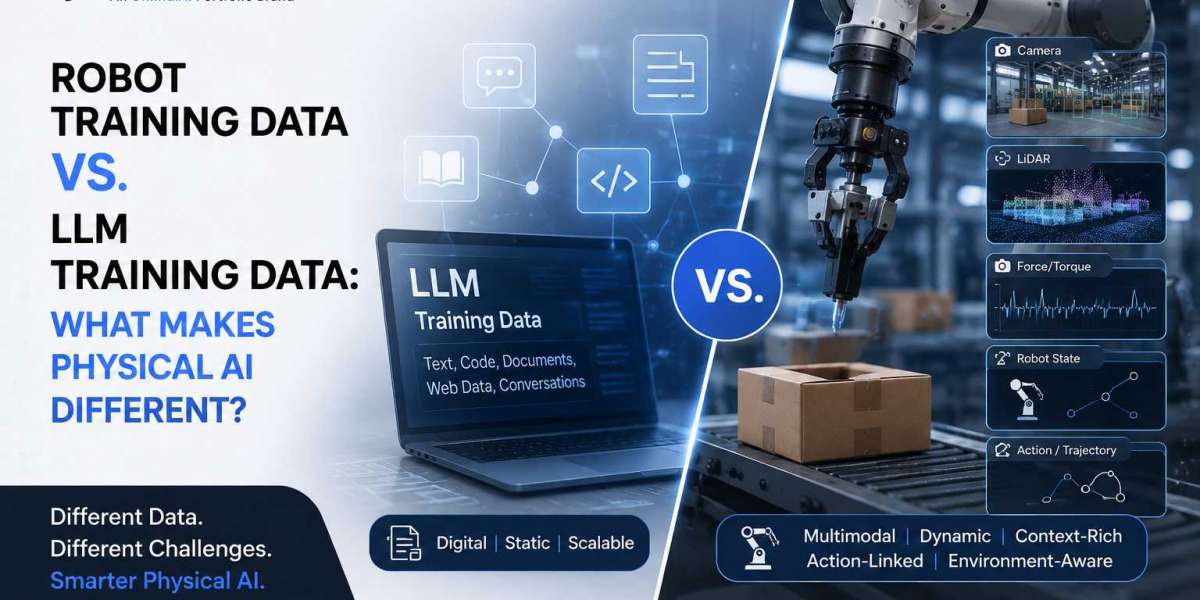

Artificial intelligence has advanced rapidly by learning from enormous volumes of digital information. Large language models (LLMs), for example, are trained on text, code, images, and other digital content to recognize patterns and generate useful outputs. But when AI moves from a screen into the physical world, the nature of training changes dramatically.
Robots cannot simply predict the next word or classify an image. They must perceive their surroundings, understand spatial relationships, make decisions, move safely, and respond to constantly changing physical conditions. This is why robotic training data is fundamentally different from the datasets used to train conventional AI and LLMs.
For companies developing humanoids, autonomous mobile robots, warehouse systems, surgical robots, or other embodied AI applications, understanding this difference is essential for building capable and reliable physical AI systems.
What Is LLM Training Data?
LLMs learn primarily from digital information such as books, websites, articles, conversations, documents, and source code. Their training objective is generally centered around understanding relationships between tokens and predicting or generating sequences of language.
The data is largely static. A sentence remains the same regardless of whether the model processes it today or tomorrow. While LLM datasets require extensive cleaning, filtering, labeling, and quality control, the underlying information does not physically interact with the model.
This makes LLM data highly scalable. Large datasets can be collected from digital sources, processed computationally, and used to train increasingly sophisticated models.
Physical AI faces a different challenge.
Robots Learn Through Interaction
A robot does not operate in a purely digital environment. It interacts with objects, surfaces, people, tools, and unpredictable surroundings.
Consider a warehouse robot tasked with picking a package. It needs to determine where the package is located, identify its orientation, estimate its dimensions, plan a grasp, move its arm, adjust its grip, and place the package correctly. A small change in lighting, object position, friction, or packaging can alter the required behavior.
The training data therefore needs to capture much more than what an object looks like.
It may need to represent:
Camera and video observations
LiDAR and depth information
Robot joint positions
End-effector movements
Force and torque measurements
Grasp and manipulation actions
Robot trajectories
Environmental conditions
Human demonstrations
Task outcomes and failures
This combination of perception, action, and environment makes robotic training data inherently multidimensional.
The Importance of Action-Linked Data
One of the biggest differences between LLM training data and robot data is the connection between information and physical action.
An LLM can generate an answer based on patterns learned from language. A robot must translate perception into an action that produces a real-world result.
For example, identifying a cup in an image is only the beginning. A manipulation robot must understand how to approach the cup, where to grasp it, how much force to apply, and how to move it without dropping or damaging it.
This means robotic datasets often need synchronized information across multiple modalities. Visual observations must correspond accurately with robot actions and sensor readings.
A mislabeled image may reduce the performance of a computer vision model. An incorrect action label in a robotics dataset can teach a robot the wrong behavior entirely.
Physical AI Requires Multimodal Training Data
LLMs can be multimodal, but physical AI is inherently multimodal because robots depend on multiple sensors and action systems simultaneously.
A humanoid robot, for instance, may use cameras to understand its surroundings, microphones to process spoken instructions, tactile sensors to detect contact, and proprioceptive sensors to understand its own body position.
Effective training therefore requires data that connects these signals.
This is where professional robotic data collection becomes particularly important. Instead of collecting isolated datasets, teams need coordinated recordings that preserve temporal relationships between what the robot observes, what it does, and what happens afterward.
The result is a richer training environment that can support perception, planning, control, and decision-making.
Real-World Variability Makes Robotics Harder
Digital datasets can be enormous, but physical environments introduce variability that is difficult to capture through conventional data sources.
Objects can be partially occluded. Lighting can change. Floors can be slippery. People can move unpredictably. Objects can be damaged, misplaced, or presented in unfamiliar orientations.
Robots must learn to operate despite these variations.
This creates a strong demand for diverse and representative data covering both common scenarios and long-tail edge cases. A robot trained only on ideal laboratory conditions may struggle when deployed in a busy warehouse or home.
High-quality robotic data collection should therefore include variations in environments, objects, lighting, motion, human behavior, and task conditions.
Human Demonstrations Add Another Layer
Human expertise is particularly valuable when robots need to learn complex manipulation or task sequences.
Through teleoperation, demonstrations, or guided interactions, humans can show robots how tasks should be performed. These demonstrations can capture not only successful actions but also adjustments made during the task.
For example, when a human notices that an object is slipping, they instinctively modify their grip or movement. Capturing such corrective behavior can provide valuable information for training robotic policies.
This makes demonstration data an important component of modern physical AI development.
Quality Matters More Than Dataset Size Alone
For LLMs, increasing dataset size can contribute significantly to model capability. In robotics, however, more data does not automatically mean better performance.
A massive dataset containing inconsistent labels, poorly synchronized sensors, repetitive behaviors, or limited environmental diversity may be less valuable than a smaller dataset with high-quality demonstrations and comprehensive coverage.
Robotics teams therefore need rigorous processes for data validation, annotation, synchronization, quality assurance, and dataset management.
The objective is not simply to collect more data. It is to collect the right data for the robot's intended tasks and operating environments.
From Data to Physical Intelligence
The ultimate goal of robot training is not simply recognition or prediction. It is reliable physical behavior.
That requires datasets capable of teaching robots how perception connects to decisions and how decisions connect to actions. As embodied AI advances, the importance of high-quality training data will increase across applications ranging from logistics and manufacturing to healthcare, service robotics, and humanoid systems.
For companies developing physical AI, investing in scalable robotic data collection and carefully engineered robotic training data can become a critical competitive advantage.
Conclusion
LLM training data teaches models to understand and generate information. Robot training data must teach machines to perceive, reason, act, and adapt within the physical world.
That distinction makes physical AI considerably more data-intensive and operationally complex. Robots need synchronized multimodal signals, action-oriented demonstrations, environmental diversity, and real-world edge cases that conventional digital datasets cannot fully provide.
As robots move beyond controlled environments and into everyday settings, the organizations capable of building high-quality, diverse, and task-relevant robotic datasets will be better positioned to develop reliable physical intelligence.
For the next generation of embodied AI, better models matter—but better training data may matter even more.








