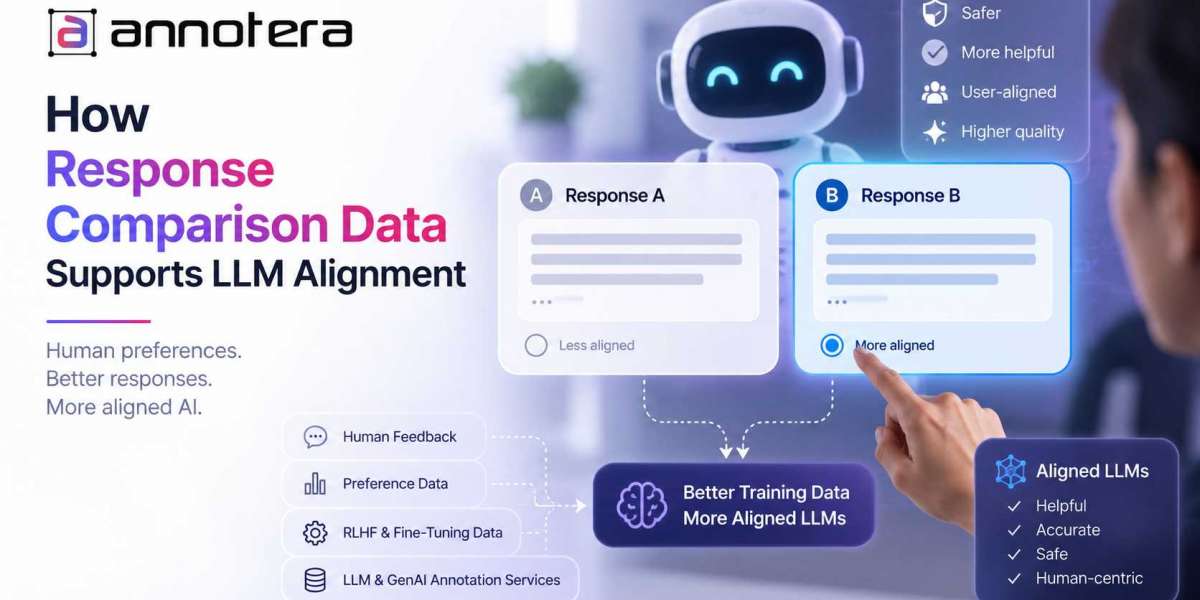

Large language models can generate fluent, informative, and contextually relevant responses, but fluency alone does not guarantee that a model will behave in ways users and organizations expect. An LLM may provide an answer that is technically correct yet unnecessarily verbose, overly cautious, misleading, biased, or poorly aligned with the user’s intent.
This is where response comparison data becomes valuable. By comparing multiple model-generated responses to the same prompt and identifying which response better satisfies defined criteria, AI teams can transform subjective human judgments into structured training signals.
Response comparison is closely associated with preference modeling and Reinforcement Learning from Human Feedback (RLHF). Research from Anthropic, for example, has examined ranked preference modeling as a method for improving alignment and found advantages over simple imitation learning in certain settings.
For organizations developing reliable generative AI systems, high-quality comparison data can therefore become an important component of LLM GenAI annotation services and RLHF fine-tuning data pipelines.
What Is Response Comparison Data?
Response comparison data consists of prompts, multiple candidate responses, and a preference judgment indicating which response better meets the specified evaluation criteria.
For example:
Prompt:
“Explain photosynthesis to a 12-year-old.”
Response A:
A technically detailed explanation using advanced biological terminology.
Response B:
A simple explanation using an analogy and age-appropriate language.
If evaluators consistently select Response B because it is clearer and more appropriate for the intended audience, that preference becomes useful training data.
Instead of simply telling a model what an answer should look like, comparison datasets teach the model which of two or more possible behaviors is preferable.
Depending on the project, evaluators may compare responses based on:
- Helpfulness
- Accuracy
- Relevance
- Instruction following
- Clarity
- Conciseness
- Factuality
- Safety
- Tone
- Reasoning quality
- Domain-specific requirements
The evaluation criteria should be established before annotation begins so that judgments remain consistent across the dataset.
Why Comparison Data Matters for LLM Alignment
Alignment involves shaping model behavior so that its outputs better reflect intended objectives, constraints, and human preferences.
A traditional supervised dataset might contain:
Prompt → Desired Answer
A preference dataset can instead contain:
Prompt → Response A vs. Response B → Preferred Response
The second format captures something important: relative quality.
In many real-world situations, there is no single perfect answer. Two responses may both be factually correct, while one is more useful, concise, empathetic, or appropriate for the context.
Comparison data allows training systems to learn these distinctions.
Anthropic's research on ranked preference modeling specifically explored using ranked preferences to train models for alignment-related objectives.
How Response Comparison Fits Into RLHF
Response comparison is particularly important in RLHF workflows.
A simplified pipeline looks like this:
1. Prompt Collection
Relevant prompts are collected from target use cases.
2. Response Generation
An LLM generates multiple responses to each prompt.
3. Human Evaluation
Annotators compare the responses according to predefined guidelines.
4. Preference Dataset Creation
The resulting rankings or pairwise preferences are converted into structured training data.
5. Preference Model Training
A reward or preference model learns to distinguish preferred responses from less-preferred alternatives.
6. Model Optimization
The preference signal can then be incorporated into an optimization process designed to increase desirable behaviors.
The underlying concept is straightforward: instead of manually specifying every desirable response, the training pipeline learns patterns from human judgments.
Anthropic has described a similar comparison-based process in which human contractors evaluated pairs of model responses according to criteria such as helpfulness or harmlessness.
Quality of Annotations Directly Affects the Training Signal
The usefulness of response comparison data depends heavily on annotation quality.
Suppose evaluators are instructed to select the most helpful response, but one annotator prioritizes brevity while another prioritizes completeness. Their judgments may become inconsistent.
This creates noisy preference data.
Common causes of annotation inconsistency include:
- Ambiguous evaluation guidelines
- Inadequate domain knowledge
- Annotator fatigue
- Cultural or linguistic differences
- Unclear ranking criteria
- Poorly designed comparison interfaces
- Failure to distinguish factual accuracy from writing quality
A robust annotation program therefore requires detailed guidelines, qualification tests, calibration exercises, quality checks, and ongoing review.
For specialized applications, annotators may also need domain-specific expertise.
Designing Effective Response Comparison Datasets
Creating useful comparison data requires more than collecting large numbers of pairwise judgments.
1. Define Clear Evaluation Criteria
Annotators should know exactly what they are evaluating.
For example, a customer-service dataset may prioritize accuracy, helpfulness, politeness, and policy compliance, while a coding dataset may emphasize correctness, security, efficiency, and adherence to requirements.
2. Use Representative Prompts
The dataset should reflect the situations the model is expected to handle.
This includes straightforward requests, ambiguous prompts, complex instructions, edge cases, and potentially adversarial inputs.
3. Include Meaningful Response Differences
If two responses are virtually identical, the resulting preference provides limited information.
Useful datasets contain meaningful variations in quality, reasoning, relevance, safety, and instruction following.
4. Measure Annotator Agreement
Agreement metrics and adjudication processes can identify ambiguous examples and inconsistent judgments.
Low agreement may indicate that the instructions need refinement—or that the underlying task involves legitimate subjective differences.
5. Maintain Balanced Data
If one evaluation dimension dominates the dataset, the resulting preference model may over-optimize for that characteristic.
Anthropic's work on Constitutional AI illustrates this challenge: the weighting of harmlessness versus helpfulness in preference-model training affected the resulting behavior, highlighting the importance of balancing evaluation objectives.
Response Comparison Beyond Traditional RLHF
Response comparison is not limited to conventional human-feedback pipelines.
AI-assisted evaluation approaches can also use structured principles to compare candidate responses. Anthropic's Constitutional AI research, for example, describes using AI-generated feedback to evaluate responses against predefined principles and subsequently train a preference model.
This demonstrates how comparison frameworks can be adapted for different alignment strategies.
However, automated evaluation does not eliminate the need for thoughtful dataset design. Human oversight, carefully defined criteria, validation, and representative evaluation remain important for determining whether the preference signal actually captures the intended behavior.
How Annotera Supports Response Comparison Data
Building reliable preference datasets requires a combination of annotation expertise, quality assurance, scalable workflows, and clear evaluation frameworks.
Annotera's LLM GenAI annotation services can support AI teams in developing structured datasets for preference ranking, response comparison, instruction following, safety evaluation, and other generative AI use cases.
Our approach can incorporate:
- Pairwise response comparison
- Preference ranking
- Response quality evaluation
- Instruction-following assessment
- Factuality and relevance checks
- Safety and policy evaluation
- Annotator qualification and calibration
- Multi-level quality assurance
- Domain-specific annotation workflows
These capabilities can contribute to high-quality RLHF fine-tuning data designed around the behavioral objectives of a particular LLM application.
Building Better Alignment Through Better Data
LLM alignment is not achieved simply by increasing model size or adding more training examples. The model also needs meaningful signals that distinguish desirable behavior from less desirable alternatives.
Response comparison data provides one such signal.
By systematically comparing candidate outputs, organizations can capture nuanced judgments about helpfulness, accuracy, relevance, safety, tone, and instruction following. When these judgments are collected consistently and integrated into a well-designed training pipeline, they can help models move beyond simply generating plausible language toward producing responses that better satisfy their intended objectives.
For AI teams investing in RLHF, preference optimization, or generative AI development, the quality of the comparison dataset can therefore be just as important as the quantity of data.
Annotera helps organizations turn model responses into structured, reliable training signals. With specialized LLM GenAI annotation services and scalable RLHF fine-tuning data workflows, Annotera supports the data foundation required to develop more useful, consistent, and context-aware AI systems.








