
Large language models (LLMs) can generate fluent, informative, and context-aware responses, but language fluency alone does not guarantee that their outputs are useful, safe, accurate, or aligned with what people expect. This is where human preference data becomes important.
Human preference data provides structured signals about how people evaluate different model responses. Instead of simply teaching an LLM what to say, preference data helps indicate which response is better and why according to defined evaluation criteria. It has consequently become an important component of modern LLM post-training and alignment workflows.
For organizations developing conversational AI, copilots, coding assistants, and generative AI applications, high-quality preference datasets can provide a practical foundation for improving model behavior.
What Is Human Preference Data?
Human preference data captures judgments made by human annotators when comparing or evaluating model-generated responses.
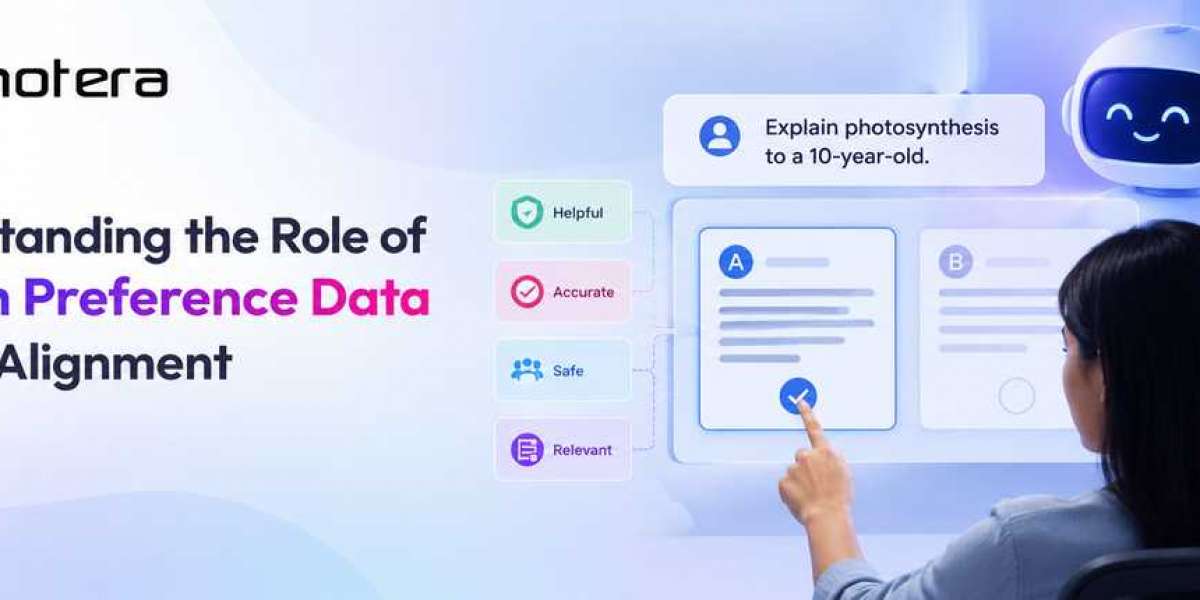
A common format presents an annotator with a prompt and two or more candidate responses. The annotator identifies the response that better satisfies the specified criteria. For example:
Prompt: Explain photosynthesis to a 10-year-old.
Response A: Provides a clear, age-appropriate explanation with a simple example.
Response B: Uses highly technical terminology and assumes advanced scientific knowledge.
If the task prioritizes clarity and age appropriateness, an annotator would typically select Response A.
These comparisons can be represented as chosen and rejected responses. Such pairwise preference data is widely used in RLHF and other preference-optimization approaches. Public research datasets, including Anthropic's HH-RLHF dataset, use this basic chosen-versus-rejected structure for helpfulness and harmlessness preferences.
Why Human Preferences Matter for LLM Alignment
Pretrained LLMs learn statistical patterns from large collections of text. However, those patterns do not inherently specify how an assistant should behave in every interaction.
A model may produce a grammatically correct response that is nevertheless:
Irrelevant to the user's question
Excessively verbose
Unclear or poorly structured
Factually questionable
Unsafe in a particular context
Unhelpfully refusing a legitimate request
Overconfident when information is uncertain
Human preference data introduces an additional behavioral signal. It helps training systems distinguish between outputs that are merely plausible and outputs that better satisfy defined human-centered objectives.
Research on preference datasets also highlights that human feedback can encode multiple attributes simultaneously, including qualities such as helpfulness, safety, correctness, and style. This makes careful dataset design particularly important.
How Human Preference Data Supports RLHF
Human preference data is closely associated with Reinforcement Learning from Human Feedback (RLHF).
A simplified RLHF workflow can involve several stages:
1. Generate Candidate Responses
A language model generates multiple responses to the same prompt. The responses may differ in accuracy, relevance, safety, reasoning quality, tone, or completeness.
2. Collect Human Comparisons
Trained annotators review the responses and identify which output better satisfies the task requirements.
3. Build a Preference Dataset
The resulting judgments are organized into structured examples containing prompts, candidate responses, preference labels, and potentially additional quality or safety annotations.
4. Train a Reward Model
In traditional RLHF pipelines, preference comparisons can be used to train a reward model that learns to estimate which responses humans are more likely to prefer.
5. Optimize the Language Model
The reward signal can then be used during model optimization to encourage behavior associated with preferred responses.
Modern alignment workflows also use approaches such as Direct Preference Optimization (DPO), which can learn directly from preference pairs without requiring the same reward-model-plus-RL pipeline used in traditional RLHF. Research on RLHF increasingly examines both these approaches and newer post-training methods.
What Makes High-Quality Preference Data?
The usefulness of a preference dataset depends on more than the number of annotations collected. Consistency, relevance, coverage, and label quality are equally important.
Several factors deserve attention:
Clear Annotation Guidelines
Annotators need precise instructions explaining what constitutes a preferred response. Criteria might include factuality, relevance, helpfulness, completeness, harmlessness, tone, or instruction-following.
Consistent Labeling
Different annotators can interpret the same response differently. Measuring agreement and investigating disagreements can help identify ambiguous guidelines or difficult examples.
Diverse Prompts
A dataset dominated by simple questions may not adequately represent the situations encountered by a production LLM. Preference data should cover different domains, languages, user intents, difficulty levels, and risk categories where relevant.
High-Value Examples
More data does not automatically mean better alignment. A 2026 ACL Findings study reported that carefully selected high-quality, low-variability preference samples achieved comparable or better alignment performance than using the full dataset in its experiments.
Quality Control
Potentially inconsistent labels, ambiguous examples, annotator disagreements, and unusual response pairs should be identified through systematic quality-control procedures.
Human Preference Data Goes Beyond "Good" and "Bad"
One of the most important aspects of preference annotation is defining what "better" actually means.
For example, a response can be helpful but unsafe. Another can be safe but unnecessarily restrictive. A third can be factually accurate but difficult to understand.
This is why modern preference datasets may separate different dimensions rather than forcing annotators to make a single overall judgment. The PKU-SafeRLHF project, for example, separates helpfulness and harmlessness annotations and includes safety metadata across multiple harm categories and severity levels.
Such multidimensional annotation can provide more informative training signals and help teams investigate trade-offs between competing objectives.
Challenges in Human Preference Data Collection
Human preference data is valuable, but it is not inherently objective.
Annotators may differ in their interpretation of quality, cultural expectations, domain knowledge, and tolerance for particular response styles. Research comparing human and LLM preferences has also found meaningful differences in what different evaluators prioritize.
Other challenges include:
Annotation fatigue
Ambiguous prompts
Subjective evaluation criteria
Label noise
Inconsistent application of guidelines
Insufficient domain expertise
Bias in the annotator population
Limited representation of edge cases
These issues make annotation methodology and quality assurance critical components of an alignment-data pipeline.
The Role of Specialized Annotation Services
Building reliable preference datasets requires more than assigning labels to model outputs. It requires carefully designed workflows covering task definition, annotator training, quality checks, disagreement analysis, dataset documentation, and iterative refinement.
This is where LLM GenAI annotation services can support AI development teams.
Specialized annotation workflows can help organizations create datasets for instruction following, response ranking, safety evaluation, factuality assessment, sentiment, conversational quality, reasoning, and other model behaviors.
For teams developing RLHF fine-tuning data, structured human feedback can also provide valuable signals for post-training and evaluation workflows.
The objective is not simply to collect the largest possible volume of judgments. It is to produce preference data that accurately represents the behavioral characteristics a model is expected to learn.
Building Better Alignment Through Better Data
Human preference data effectively acts as a bridge between model capability and desired behavior. Pretraining gives an LLM broad language and knowledge capabilities, while post-training uses additional signals to shape how those capabilities are expressed.
However, preference data should be treated as a carefully engineered dataset rather than an unquestioned representation of universal human values. Its effectiveness depends on who provides the feedback, how tasks are designed, what criteria are measured, and how disagreements and biases are handled.
For this reason, organizations investing in LLM development should consider preference-data quality alongside model architecture and training scale.
Conclusion
Human preference data plays a central role in helping LLMs move from simply generating plausible text toward producing responses that better satisfy defined expectations for usefulness, safety, relevance, and quality.
From pairwise response comparisons to multidimensional safety and helpfulness labels, carefully collected feedback provides valuable training signals for modern alignment methods. As LLM development continues to evolve, the focus is increasingly shifting toward high-quality, well-curated, task-specific preference data rather than data volume alone.
For AI teams looking to strengthen post-training pipelines, combining rigorous human annotation, quality control, and carefully designed RLHF fine-tuning data can provide a stronger foundation for developing reliable and useful generative AI systems.