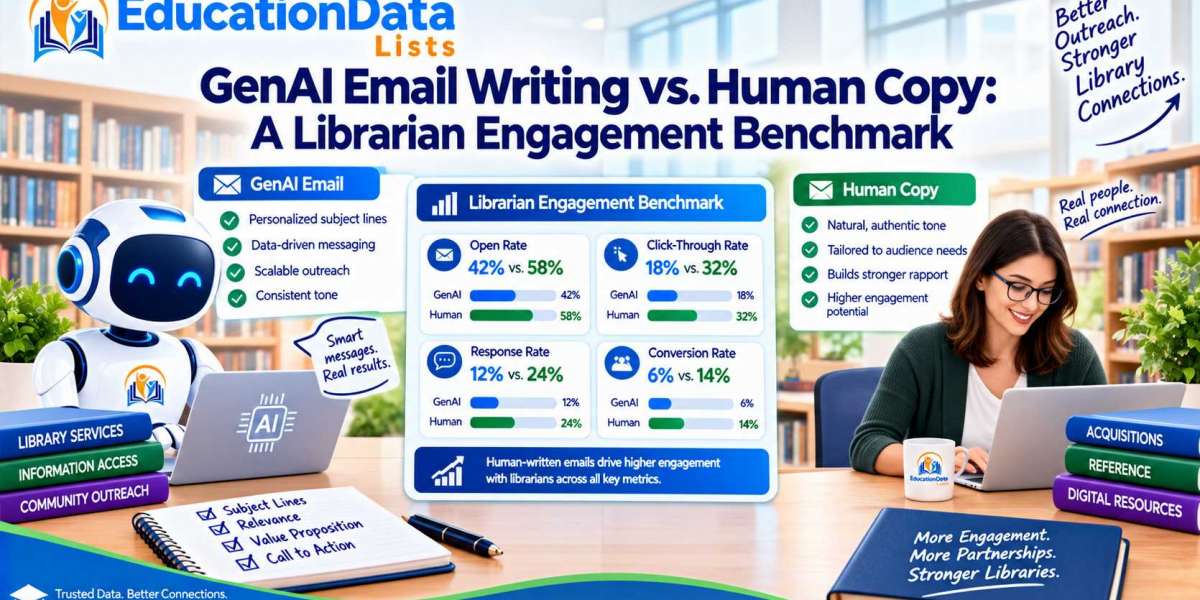

Can GenAI-written emails engage librarians as effectively as human-written copy? Current evidence does not provide a librarian-specific head-to-head answer, but recent research offers a useful benchmark. A 2026 randomized field-study program comparing human, LLM-generated, and hybrid email content found that AI-generated emails could perform competitively with professionally written copy, while Deloitte's 2025 experiment found GenAI and human copy each had distinct strengths.
For marketers using a Librarian Email List, however, the question is more nuanced. Librarians operate in an environment where information quality, privacy, professional judgment, and trust matter. Clarivate's 2025 Pulse of the Library report found that 67% of libraries were exploring or implementing AI, up from 63% in 2024. The opportunity is therefore not simply to replace human copywriting with AI, but to determine where AI can accelerate production without sacrificing the context librarians expect from professional communications.
What Does the Latest AI vs. Human Email Research Show?
The strongest recent evidence comes from a peer-reviewed study by Jean-Pierre Dubé and Ariel Xu, published in Quantitative Marketing and Economics in January 2026.
The researchers conducted three randomized controlled field experiments at Wine Access. The first experiment compared four groups: no email, human-written content, LLM-generated content, and hybrid content in which an LLM produced the draft and a human edited it. A later experiment modified the hybrid approach, and a third experiment conducted in 2025 tested a general-purpose GPT/Claude approach.
The study was not conducted with librarians, so its results should not be interpreted as a librarian engagement benchmark. Its value is methodological: it demonstrates that marketers can isolate the effect of the content-generation method under controlled conditions.
The researchers found that the AI and hybrid approaches could produce commercially competitive results with human-written email. Across the experiments, the email treatments generated substantially more gross profit than the no-email control, although the precise outcome varied by experiment and content-generation method.
For a Librarian Mailing List, the lesson is to test AI against human and hybrid alternatives rather than assuming that one writing method will consistently outperform the others.
What Did Deloitte Find When It Tested GenAI Against Human Copywriters?
Deloitte Digital conducted a separate 2025 experiment involving 1,000 consumers who evaluated emails produced by two experienced human copywriters and two large language models. The same creative brief was provided to both humans and AI, covering audience characteristics, brand voice, and desired actions.
The results were mixed.
For five content-quality criteria—including personalization, relevance, readability, clarity, and actionability—GenAI-produced emails received ratings approximately 4.5% higher on average than human-written emails. GenAI's advantage was strongest on perceived personalization, where its ratings were nearly 7% higher.
But human copy had an important advantage when the researchers looked at stronger action responses. Human-written emails were 6.4% more likely to receive high ratings for likelihood to act, and in some demographic subsets the difference approached 20%. Deloitte concluded that GenAI was highly effective as a collaborator but that human creativity, context, and judgment remained important.
The experiment therefore does not establish a universal winner. It suggests that AI can produce polished and relevant drafts rapidly, while human writers may create more distinctive responses among people who are strongly motivated to act.
Why Is This Especially Relevant to Librarian Outreach?
Librarians are increasingly dealing with AI themselves, which changes the context in which vendor messages are evaluated.
Clarivate's Pulse of the Library 2025 surveyed more than 2,000 librarians globally across academic, public, and national libraries. The report found that 67% of libraries were exploring or implementing AI, compared with 63% in 2024. Within that group, 35% remained at the evaluation stage while 33% had reached implementation stages.
This is important because a librarian receiving an AI-related vendor email may already understand the technology's benefits and limitations.
At the same time, the American Library Association's 2026 guidance emphasizes that AI adoption should preserve human judgment, professional expertise, privacy, accountability, and public trust. ALA specifically states that AI should not replace staff judgment or accountability and recommends evaluating AI-enabled vendor integrations against professional values, ethics, local policy, applicable law, and community needs.
That makes generic AI hype particularly weak positioning for librarian audiences.
A better email should explain:
What specific library problem the solution addresses
What evidence supports the claim
How patron or staff data is handled
What human oversight remains
How the technology integrates with existing workflows
What practical outcome the library can expect
Librarians Are Exploring AI, but Access to AI Training Is Uneven
AI adoption does not mean every librarian has the same level of AI knowledge.
Clarivate reported in 2026 that 70% of librarians had no formal access or dedicated time for AI learning, according to its 2025 Pulse of the Library findings.
That creates an interesting challenge for marketers.
An AI-generated campaign might allow a vendor to create highly segmented content quickly, but the resulting copy still needs to account for differences between an academic librarian, public librarian, special librarian, school librarian, and library technology professional.
For example, an academic librarian may care about research workflows, discovery, scholarly resources, or AI literacy. A public librarian may be more concerned with patron access, digital literacy, community programming, privacy, and equitable services.
A Librarian Email Database becomes more valuable when those distinctions can inform the messaging rather than simply increasing the number of contacts reached.
Does AI Actually Make Email Production More Efficient?
Efficiency is one area where the evidence is much clearer.
In Deloitte's experiment, an engineer could produce the AI-generated emails in minutes, while the human copywriters spent an average of four hours writing each email. Deloitte also reported that the token cost of generating all eight tested emails was less than one dollar.
That difference has practical implications for segmented librarian outreach.
Suppose a vendor wants to test different messages for:
Public library directors
Academic library directors
Collection-development librarians
Reference librarians
Digital-services librarians
Library technology managers
School librarians
Creating seven genuinely different human-written campaigns can require substantial production time. GenAI can create initial variations much faster.
But speed should be treated as a production advantage—not proof of better engagement.
Deloitte itself emphasizes that AI works best as an assistant, with humans supplying context, review, and judgment.
Why Human Review Matters for Librarian Audiences
Library communications involve subjects where factual precision and professional context matter.
ALA's 2026 AI guidance recommends that libraries assess AI systems for benefits, risks, safeguards, staff capacity, community effects, and appropriate AI and non-AI alternatives. It also recommends preserving professional library expertise, including cataloging, subject knowledge, access services, instructional design, reference, readers' advisory, and community support.
This provides a useful framework for vendor outreach.
AI-generated copy should be checked for:
Accuracy — Are product claims supported?
Context — Does the message understand the recipient's library environment?
Privacy language — Are data-handling statements accurate?
Professional terminology — Does the copy use appropriate library terminology?
Tone — Does it respect the recipient's professional expertise?
Specificity — Does it address a real problem rather than simply mention AI?
A human editor familiar with libraries can often identify these issues faster than a generic copy-generation workflow.
What Email Benchmarks Can Tell Us About Engagement
There is no reliable public benchmark specifically measuring cold-email engagement among librarians. However, broader email data provides useful context.
MailerLite analyzed more than 3.6 million campaigns from 181,000 approved accounts sent between December 2024 and November 2025. Across all industries, the median open rate was 43.46%, click rate was 2.09%, click-to-open rate was 6.81%, and unsubscribe rate was 0.22%.
For higher education, MailerLite reported a 43.98% open rate, 2.15% click rate, 9.15% click-to-open rate, and 0.10% unsubscribe rate. This is not a librarian-specific benchmark, but it can provide a closer contextual comparison than a general cross-industry number.
Cold outreach is different.
Belkins analyzed 7,530,489 cold emails sent during 2025 and reported an overall reply rate of 0.45%, using total emails sent—not opens—as the denominator. Education was among the stronger-performing industries in its dataset, but the study did not publish a librarian-specific rate.
Therefore, marketers should not claim that librarians have a particular response rate based on these datasets. Instead, they should use the figures as external reference points while building their own librarian-specific benchmark.
Should Marketers Compare AI, Human, and Hybrid Copy?
Yes. A three-cell test is more informative than choosing a writing method based on assumptions.
Test A: Human-written copy
A marketer or library-industry specialist writes the email from scratch.
Test B: GenAI-written copy
GenAI generates the email using the same offer, audience definition, value proposition, tone, and CTA.
Test C: Human-edited AI copy
GenAI creates the first draft, then a human familiar with the library market reviews and rewrites it.
Keep the campaign variables as consistent as possible:
Audience segment
Sender identity
Offer
Landing page
CTA
Sending period
Follow-up process
Contact-data quality
Then compare meaningful outcomes.
Which Metrics Should Be Measured?
Track:
Delivery rate
Bounce rate
Click-through rate
Positive reply rate
Qualified reply rate
Meeting or demo rate
Unsubscribe rate
Spam complaints
Sales-qualified opportunities
Pipeline generated
Open rate can provide directional information, but it should not be treated as the primary success metric. MailerLite notes that Apple Mail Privacy Protection can inflate reported opens, making click activity a more reliable engagement indicator.
What Should a GenAI Email to a Librarian Look Like?
A strong AI-assisted email should begin with the recipient's professional context rather than the technology itself.
For example, instead of:
“Our revolutionary AI platform is transforming libraries.”
a stronger structure would be:
“Libraries are increasingly evaluating AI tools for discovery and staff workflows. Here's how three organizations are testing automated research assistance while keeping human review in the process.”
The second approach provides a concrete issue and acknowledges the human role.
That distinction matters because librarians are not simply another technology-buying audience. ALA's current guidance explicitly emphasizes human-centered implementation, professional accountability, privacy, and community needs.
5 Practical Takeaways for Librarian Outreach
1. Use AI to increase testing capacity
GenAI can rapidly produce alternative subject lines, introductions, value propositions, and calls to action. Use that speed to test more hypotheses rather than simply sending more emails.
2. Give AI librarian-specific context
A prompt that only says “write an email to librarians” is unlikely to produce strong professional relevance. Include library type, recipient role, problem, product category, evidence, and desired outcome.
3. Keep humans in the review loop
Check factual claims, privacy statements, terminology, and tone before sending. ALA's current guidance reinforces the importance of human judgment and accountability around AI use in libraries.
4. Measure clicks and qualified responses
Don't judge an AI campaign by open rate alone. Compare positive replies, qualified conversations, meetings, and downstream opportunities.
5. Segment the Librarian Email List
Separate public, academic, school, and specialized library audiences where the available data supports that distinction. Different library environments can have substantially different priorities and technology contexts.
How EducationDataLists Can Support the Strategy
For organizations building targeted library outreach programs, EducationDataLists can provide a Librarian Email List as a foundation for audience segmentation and campaign testing.
The database itself should not replace research or personalization. Its role is to help marketers identify the relevant audience, organize contacts by available attributes, and create controlled campaign segments. GenAI can then accelerate copy development while human reviewers maintain accuracy and professional relevance.
The strongest workflow is therefore not database + AI = automatic engagement. It is accurate audience data + relevant segmentation + AI-assisted production + human review + controlled measurement.
Conclusion
Current research does not establish a universal engagement winner between GenAI and human-written email for librarians. There is no credible public librarian-specific experiment that provides such a ranking. However, the broader evidence is useful: a 2026 randomized email-marketing study demonstrates that LLM-generated and hybrid copy can compete with human-written content, while Deloitte's 2025 experiment shows that GenAI can produce strong content ratings and dramatically reduce production time, but human-written copy can still generate stronger high-intent responses.
Meanwhile, librarian-specific research shows that AI is becoming increasingly relevant to libraries, with 67% exploring or implementing AI in Clarivate's 2025 global survey. For marketers using a Librarian Mailing List, the opportunity is to combine that growing AI capability with accurate audience segmentation, human review, and rigorous campaign testing. The most useful benchmark will ultimately be the one built from controlled tests against the marketer's own librarian audience.
Frequently Asked Questions
Is GenAI better than human copy for librarian emails?
There is currently no credible public study proving that GenAI consistently outperforms human copy specifically among librarians. Broader experiments show that AI can produce competitive email content while humans can retain advantages in contextual judgment and high-intent responses.
What is the average email engagement rate for librarians?
A librarian-specific public benchmark is not currently available. MailerLite's 2025 benchmark across more than 3.6 million campaigns was 43.46% for opens and 2.09% for clicks, while its higher-education segment recorded a 43.98% open rate and 2.15% click rate; these should be treated as contextual benchmarks rather than librarian-specific results.
Are libraries adopting generative AI?
Yes, current evidence shows substantial exploration and implementation. Clarivate's 2025 Pulse of the Library report found that 67% of libraries were exploring or implementing AI, compared with 63% in 2024.
Should AI-generated librarian emails be reviewed by humans?
Human review is advisable, particularly for claims involving privacy, security, AI capabilities, product functionality, or professional practices. ALA's 2026 guidance emphasizes preserving human judgment and accountability when libraries use AI.
What should a Librarian Email List campaign focus on?
The campaign should focus on a specific professional problem and explain how the vendor can address it. Depending on the audience, relevant topics may include discovery, digital literacy, research support, collections, workflow efficiency, accessibility, privacy, or AI literacy.
How should marketers test AI versus human email copy?
Use comparable audience segments and create at least three test groups: human-written, AI-generated, and AI-generated with human editing. Keep the offer, sender, CTA, landing page, and campaign conditions consistent, then compare clicks, positive replies, qualified meetings, unsubscribes, and pipeline.
Why is librarian-specific segmentation important?
Libraries differ substantially by type and mission. Public, academic, school, and specialized libraries can have different technology requirements, budgets, patron populations, and decision-making processes, making a generic message less informative than role- and institution-specific outreach.
What is the difference between a Librarian Mailing List and a Librarian Email Database?
The terms are often used interchangeably. A mailing list generally emphasizes the contacts available for outreach, while an email database can emphasize the broader collection of contact and organizational information used for segmentation, targeting, and campaign management.