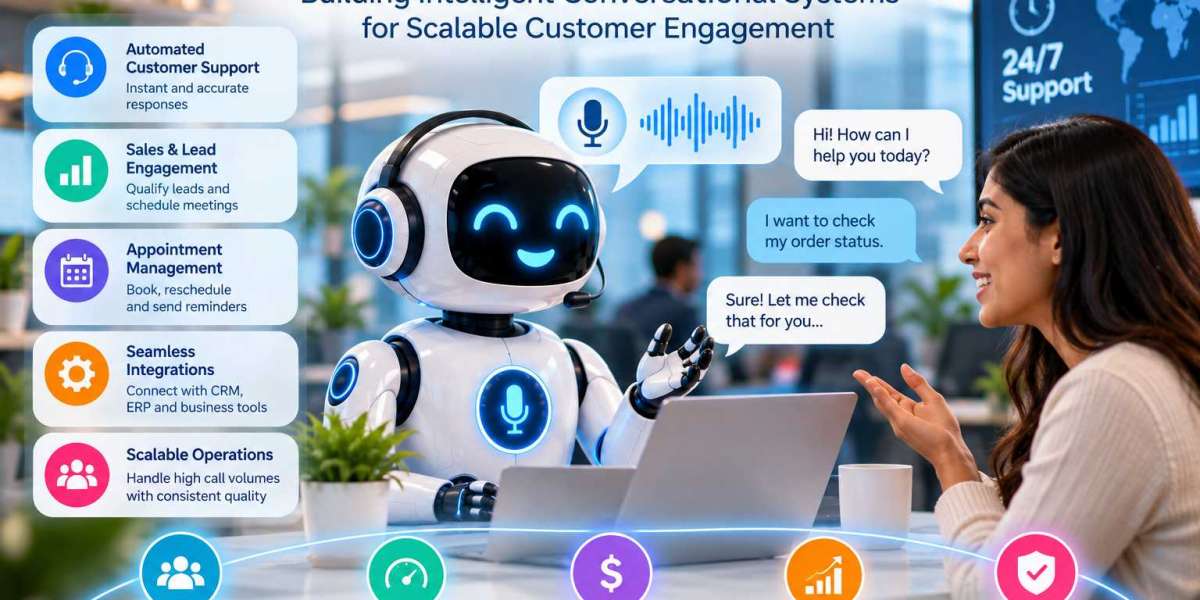

Customer expectations have changed the way businesses handle conversations. People want quick answers, clear information, and support without waiting through long phone menus. AI Voice Agent Development Services are helping enterprises respond to that demand by combining natural speech, intelligent reasoning, and automated business workflows.
The technology is no longer limited to simple call routing. Modern voice agents can understand customer intent, maintain context, retrieve approved information, and trigger actions across connected systems. For enterprises, the bigger opportunity is creating a reliable conversational layer that can scale without making every interaction dependent on a human support representative.
What Are Enterprise AI Voice Agents?
An enterprise voice agent is an AI-powered system designed to communicate with customers or employees through spoken conversations. It combines speech recognition, natural language processing, language models, text-to-speech technology, and integrations with business software.
Unlike traditional IVR systems, which rely heavily on predefined menus, AI Voice Agent Development focuses on understanding what a person actually says.
A customer can explain an issue naturally rather than selecting several options. The system interprets the request, identifies the relevant workflow, and responds based on available information and business rules.
A typical enterprise voice architecture includes:
Speech-to-text processing
Intent and context detection
AI reasoning and response generation
Text-to-speech conversion
Enterprise API integrations
Authentication and access controls
Conversation logging and analytics
Human escalation mechanisms
Each component plays a role. If one part performs poorly, the entire customer experience can suffer.
Why Voice Matters for Customer Engagement
Voice remains one of the most direct ways for people to communicate with a business. Customers can explain a problem faster by speaking than by navigating a long web form.
Voice AI Solutions can support this behavior while reducing the workload associated with repetitive interactions.
Consider a customer calling about a delayed order. A voice agent could verify the customer's identity, retrieve the latest order status, explain the expected delivery window, and offer additional assistance.
The important detail is that the agent is connected to operational data. It is not simply reading a static script.
Designing Scalable Conversational Workflows
Enterprise voice systems need structure. A natural conversation does not mean an uncontrolled conversation.
The workflow should define what the agent can understand, what information it can access, which actions it can perform, and when it must transfer the interaction to a human.
A well-designed workflow might follow this pattern:
Identify the caller.
Understand the reason for the call.
Collect missing information.
Retrieve authorized data.
Complete the appropriate action.
Confirm the result.
Escalate when required.
This structure gives the AI enough flexibility to communicate naturally while keeping business operations predictable.
Where AI Voice Automation Creates Value
AI Voice Automation works particularly well for high-volume processes with clear rules.
Customer support is one obvious area. Businesses can automate routine enquiries about orders, appointments, account information, service availability, and basic troubleshooting.
Sales teams can also use voice workflows to qualify leads, collect requirements, confirm interest, and schedule meetings.
Other practical applications include:
Appointment reminders
Delivery confirmations
Customer feedback
Service requests
Account enquiries
Internal employee support
Lead qualification
Basic technical assistance
The goal should not be maximum automation. The goal should be useful automation. A process that requires empathy, negotiation, or complex judgment may still be better handled by a person.
Making Conversations Feel Natural
Conversational Voice AI needs to account for how people actually speak.
Customers interrupt. They pause. They correct themselves. They provide several pieces of information in one sentence. Sometimes they change the subject halfway through a call.
A rigid system can quickly become frustrating.
Good conversation design uses short responses and clear questions. It also remembers relevant information already provided by the caller. If a customer has already supplied their order number, asking for it again creates unnecessary friction.
Testing should cover realistic conditions such as:
Background noise
Different accents
Unclear pronunciation
Interruptions
Multiple requests
Unexpected answers
Long pauses
Changes in customer intent
These scenarios often expose problems that a scripted demo will never reveal.
Connecting Voice Agents With Enterprise Systems
The real strength of an enterprise voice system comes from integration.
An AI Voice Assistant Development project may need to connect with CRM platforms, helpdesk tools, ERP systems, appointment software, knowledge bases, billing applications, and internal databases.
APIs allow the conversational layer to communicate with these systems. But integration should always be governed by permissions.
The agent might be allowed to read an order status but not modify the order. It might create a support ticket but require employee approval before closing a complaint.
This distinction is essential for enterprise deployment.
Security and Responsible Voice AI
Voice conversations can contain personal information, account details, payment-related data, and confidential business information.
Security should therefore be designed into the system from the beginning.
Important controls can include:
Identity verification
Role-based access
Encryption
Secure API authentication
Audit logs
Data retention controls
Monitoring
Human approval for sensitive operations
Transparency also matters. Customers should understand when they are interacting with an AI system, particularly when the conversation involves important account or service decisions.
Enterprises should establish clear policies covering data handling, escalation, model monitoring, and accountability before expanding voice automation across multiple departments.
Measuring Enterprise Voice Performance
A voice agent needs measurable objectives. Call volume alone does not tell the full story.
Useful performance indicators include:
Customer satisfaction
Task completion rate
First-contact resolution
Average handling time
Human escalation rate
Call abandonment
Recognition accuracy
Cost per interaction
Successful workflow completion
Teams should pay close attention to failed conversations. They can reveal missing knowledge, poor prompts, weak integrations, or workflows that are unsuitable for automation.
Continuous improvement should be part of the operating model rather than something performed only after a major problem occurs.
Building Voice Agents That Scale
Scalability is more than handling thousands of simultaneous calls. The system also needs to accommodate new workflows, additional languages, changing business rules, and expanding integrations.
This is where AI Product Engineering Services can support a broader product strategy. Voice capabilities can be treated as one component of an intelligent technology platform rather than an isolated call-center feature.
A phased approach is usually easier to manage. Businesses can begin with one high-volume workflow, establish performance benchmarks, test the system with real scenarios, and expand once the results are consistent.
For organizations exploring connected technologies, a Blockchain Development Company may also be relevant when voice workflows involve decentralized identity, verifiable records, or transaction-related requirements. The technology should be introduced only when it addresses a defined operational need.
Challenges Enterprises Should Prepare For
Voice AI offers strong possibilities, but implementation is not friction-free.
Speech recognition can struggle with noise or unusual accents. Customers may ask questions outside the agent's knowledge. Enterprise integrations can contain outdated information. Business rules can also change faster than the conversational system is updated.
Organizations should prepare for these situations with:
Regular knowledge-base updates
Conversation testing
Clear escalation rules
System monitoring
Access reviews
Model evaluation
Customer feedback loops
A voice agent should be treated as an evolving business system. Launching it is only the beginning.
The Future of Intelligent Customer Engagement
Enterprise voice technology is moving toward more capable conversational systems that can coordinate multiple business actions during a single interaction.
A customer could explain a problem once, while the system verifies identity, checks account information, creates a service request, schedules an appointment, and confirms the next step.
That does not mean humans disappear from customer support. Instead, employees can spend more time on situations where judgment, empathy, and problem-solving matter most.
The strongest enterprise implementations will combine automation with human oversight. They will focus on useful workflows, secure integrations, measurable outcomes, and conversations that respect the customer's time.
HyprForge helps businesses explore intelligent technology, automation, and modern product development approaches. Organizations evaluating enterprise voice systems can explore the HyprForge homepage to understand how these capabilities can fit into broader digital transformation initiatives.
FAQs
What is an enterprise AI voice agent?
An enterprise AI voice agent is a software system that communicates through spoken language while connecting to business applications, data sources, and predefined workflows.
How can voice agents improve customer engagement?
Voice agents can provide faster responses, handle repetitive requests, offer support around the clock, and connect customers with the appropriate workflow or human representative.
Can enterprise voice agents integrate with CRM systems?
Yes. Voice agents can integrate with CRM platforms through APIs and approved connectors. Depending on permissions, they can retrieve customer information, update records, create tasks, or initiate predefined workflows.
Are AI voice agents secure for enterprise use?
They can be designed for enterprise environments using authentication, encryption, role-based access, audit logging, data controls, and appropriate human approval mechanisms.
What is the best way to implement an enterprise voice agent?
A practical approach is to begin with one well-defined, high-volume workflow. Measure its performance, test real customer scenarios, address failures, and gradually expand into additional use cases.