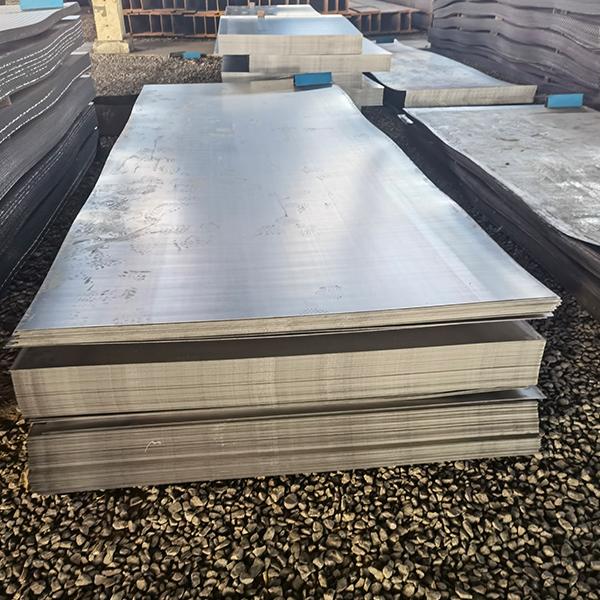
Low carbon steel sheets have become a preferred material across numerous industries due to their exceptional workability, enabling manufacturers to create complex shapes and components with relative ease. The inherent properties of low carbon steel, typically containing less than 0.25% carbon, strike an ideal balance between formability and strength, making it versatile for both manual and automated fabrication processes. This workability stems from the material’s ductility, which allows it to undergo significant deformation without cracking, a critical advantage for applications requiring intricate designs.
The manufacturing sector particularly benefits from the ease with which low carbon steel sheets can be cut, stamped, and bent. In automotive production, for instance, these sheets are pressed into body panels and structural components with precision, reducing the need for secondary processing. The material’s uniform composition ensures consistent performance during high-speed stamping operations, minimizing tool wear and production downtime. Some manufacturers have leveraged advanced laser-cutting technologies to further enhance precision, achieving tolerances as tight as ±0.1mm for complex geometries. This adaptability extends to small-scale workshops and large industrial facilities alike, proving invaluable for projects ranging from custom machinery parts to architectural features.
Another significant advantage lies in the material’s response to heat treatment. While low carbon steel sheets are not typically hardened through quenching, they can be annealed to restore ductility after cold working processes. This characteristic allows fabricators to perform multiple forming operations without compromising structural integrity. The sheets’ ability to maintain dimensional stability during welding and machining further enhances their appeal for applications requiring tight specifications. Industries such as HVAC and appliance manufacturing rely heavily on these properties to produce components that meet stringent quality standards while maintaining cost efficiency.