
Hospital-at-Home Market | When the Hospital Moves to the Patient Instead of the Patient Moving to the Hospital
For more than a century, modern healthcare revolved around a physical place.
A patient becomes ill.
They travel to a hospital.
Care happens inside a building.
That model made sense when medicine required centralized equipment, specialized staff, and continuous observation. Hospitals became the gravitational center of healthcare delivery.
But technology has quietly begun to break that assumption.
The Hospital-at-Home Market, valued at USD 17.3 billion in 2025 and projected to reach nearly USD 193.3 billion by 2035 at a CAGR of 27.3%, represents one of the most radical structural shifts in modern healthcare systems.
Instead of transporting patients to hospitals, healthcare systems are increasingly transporting hospital-level care to the patient’s home.
That transformation is not simply about convenience.
It reflects deeper pressures inside global healthcare systems—capacity shortages, rising costs, aging populations, and advances in digital health technologies.
PDF Download Hospital-at-Home Market Intelligence Sample Copy
The Real Constraint in Healthcare Is Hospital Capacity
Hospitals around the world face the same structural problem.
Demand for care continues to rise faster than physical hospital infrastructure can expand.
Several forces are driving this imbalance:
- aging populations
• increasing chronic disease prevalence
• workforce shortages in healthcare
• rising healthcare costs
• overcrowded emergency departments
Traditional hospital expansion is expensive and slow. Building new facilities requires years of planning, regulatory approval, and billions in capital investment.
The Hospital-at-Home Market addresses this problem by expanding healthcare capacity without building new hospitals.
By delivering acute care services in patients’ homes, healthcare systems can treat more patients while reducing pressure on hospital beds.
In many cases, hospital-at-home programs have demonstrated reductions in readmissions, shorter recovery times, and improved patient satisfaction.
Acute Care Services Drive the Hospital-at-Home Market
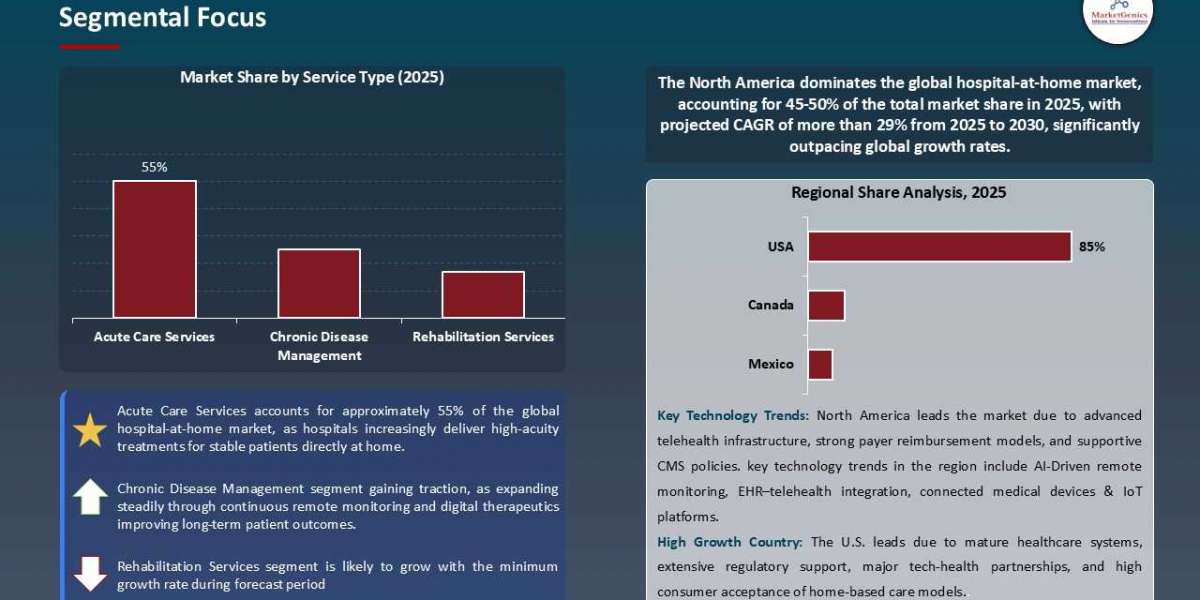
Among different service categories, acute care services account for roughly 55% of the global hospital-at-home market.
This segment includes conditions that traditionally require hospital admission but can be safely managed at home with appropriate monitoring and medical oversight.
Examples include:
- pneumonia
• heart failure exacerbations
• chronic obstructive pulmonary disease (COPD)
• post-surgical recovery
• infections requiring intravenous therapy
Hospital-at-home programs typically combine remote monitoring technologies, telemedicine consultations, and in-home clinical visits to deliver hospital-level treatment.
The goal is not to replace hospitals entirely.
It is to identify patients who are clinically stable enough to receive equivalent care outside hospital walls.
When implemented effectively, this model can replicate hospital-quality care while improving patient comfort and reducing healthcare costs.
Remote Patient Monitoring Is the Technological Backbone
The Hospital-at-Home Market depends heavily on digital health technologies that allow clinicians to monitor patients remotely.
These technologies include:
- wearable biosensors
• connected medical devices
• telehealth consultation platforms
• mobile health applications
• integrated electronic health records (EHR)
Remote patient monitoring systems continuously track vital signs such as heart rate, oxygen saturation, blood pressure, and respiratory rate.
Data flows directly to clinicians through digital dashboards, enabling real-time observation and early detection of complications.
Artificial intelligence and analytics tools increasingly assist clinicians by identifying abnormal patterns that may signal deteriorating patient conditions.
These technologies allow healthcare providers to maintain clinical oversight while patients remain at home.
Patient Preference Is Accelerating Adoption
Beyond system-level pressures, patient behavior is also pushing the Hospital-at-Home Market forward.
Many patients prefer recovering in familiar home environments rather than hospital rooms.
Home-based care offers several psychological and clinical advantages:
- reduced stress and anxiety
• improved sleep and recovery
• lower risk of hospital-acquired infections
• greater family involvement in care
Studies have shown that many patients experience improved satisfaction and faster recovery when treated at home for certain conditions.
For healthcare providers, this alignment between patient preference and system efficiency makes hospital-at-home programs particularly attractive.
Technology Is Enabling More Complex Home-Based Care
The range of conditions treatable at home continues to expand as digital health technologies evolve.
Modern hospital-at-home systems increasingly incorporate:
- AI-powered clinical decision tools
• real-time remote monitoring dashboards
• connected diagnostic equipment
• mobile laboratory services
• digital medication management platforms
These technologies allow clinicians to monitor complex conditions with a level of visibility that was previously possible only inside hospital wards.
For example, cardiac patients recovering from surgery can now be monitored remotely through wearable devices that transmit continuous cardiovascular data.
The result is a healthcare model that combines virtual oversight with in-person clinical support delivered by nurses, paramedics, and therapists visiting the patient’s home.
Integrated Care Teams Are Redefining Healthcare Delivery
Hospital-at-home programs rarely rely on a single healthcare professional.
Instead, they operate through multidisciplinary care teams that coordinate care across digital and physical channels.
These teams typically include:
- physicians overseeing treatment plans
• nurses conducting home visits
• pharmacists managing medication protocols
• therapists supporting rehabilitation
• remote monitoring specialists tracking patient data
Telehealth platforms enable daily virtual consultations while in-person visits provide hands-on clinical services such as intravenous treatments or diagnostic tests.
This hybrid care model allows healthcare systems to replicate hospital-level care while maintaining flexibility and scalability.
Regulatory Support Is Expanding the Market
Government policies and reimbursement reforms are playing a critical role in accelerating the Hospital-at-Home Market.
Healthcare systems historically depended on reimbursement models tied to inpatient hospital stays.
Recent policy changes in several countries have begun recognizing hospital-at-home care as an eligible reimbursable service.
These reforms remove financial barriers that previously limited the adoption of home-based acute care programs.
Investments in digital health infrastructure, telehealth expansion, and remote monitoring technologies further support the transition toward decentralized healthcare delivery.
As regulatory frameworks evolve, hospital-at-home programs are expected to expand across more healthcare systems worldwide.
North America Leads the Hospital-at-Home Market
North America currently holds the largest Hospital-at-Home Market share.
Several factors contribute to this leadership:
- advanced healthcare infrastructure
• strong telehealth adoption
• supportive reimbursement policies
• high healthcare expenditure
• widespread digital health innovation
Major healthcare systems across the United States and Canada have launched hospital-at-home initiatives designed to reduce hospital overcrowding and improve patient outcomes.
Programs combining virtual physician oversight with in-home nursing support have demonstrated promising results in treating acute conditions outside traditional hospital environments.
These successes are encouraging further expansion of home-based care models across the region.
A Growing Ecosystem of Healthcare and Technology Providers
The Hospital-at-Home Market is supported by a rapidly expanding ecosystem of healthcare providers and technology companies.
Leading organizations shaping the market include:
- Contessa Health
• Medically Home
• Kaiser Permanente
• Atrium Health
• Mercy Virtual
These organizations combine clinical expertise with digital platforms capable of coordinating remote monitoring, virtual consultations, and in-home medical services.
Technology vendors, telehealth providers, and home healthcare agencies also play critical roles in enabling large-scale deployment of hospital-at-home programs.
Together, these participants are building a new infrastructure for decentralized healthcare delivery.
What the Hospital-at-Home Market Is Really Pricing
At first glance, the Hospital-at-Home Market appears to be a digital health trend driven by telemedicine and remote monitoring.
But the deeper transformation lies in how healthcare systems organize care itself.
Hospitals historically concentrated care in physical buildings.
Hospital-at-home models distribute care across digital platforms, home environments, and mobile clinical teams.
The shift represents a move from location-based healthcare to network-based healthcare.
Instead of asking where care happens, healthcare systems increasingly ask how care can be delivered most efficiently and safely.
As technology continues to evolve, the boundary between hospital and home will likely become increasingly blurred.
Where MarketGenics Enters the Conversation
Most discussions around the Hospital-at-Home Market focus on telehealth platforms or remote monitoring technologies.
But the more significant story lies deeper in the transformation of healthcare infrastructure.
Hospital-at-home programs combine clinical innovation, digital health technology, reimbursement reform, and patient-centered care models into a single system.
Understanding this market requires examining how these forces interact—how healthcare delivery moves beyond hospital walls while maintaining safety, efficiency, and clinical quality.
That transformation is still unfolding.
And like many healthcare revolutions, its full impact may only become visible after the model becomes widely adopted.








